Old Testament Reading: Deuteronomy 6:1-9, 20-25
New Testament Reading: Jude 1-25
In Search of the Old Paths
“The Apostles’ Creed”
Jude 12-25
Wayne J. Edwards, Pastor
The closer we get to the end of the Church Age, the more those who claim to be Christians, but aren’t, will be seduced and pulled away from the true gospel, and deceived into attending those types of churches that are long on Christian-lite entertainment and spiritualism, and short on basic theology and sound doctrine.
- Those who say, “I don’t need theology, just give me Jesus,” have accepted a carnal view of Christianity, which rejects the Bible as the divinely inspired, infallible, and inerrant Word of God; sufficient for all matters of faith and the practice of our faith, including the essential doctrines of the Christian Faith.
- A carnal view of Christianity manifests itself in a low view of God, a low view of Jesus Christ, including His sacrificial death on the cross, a high view of self, and a low view of their sins.
- In effect, rather than resting upon the saving grace of God, they are presuming upon it.
In 1 Peter 2:1-2, the Apostle wrote: “Therefore, laying aside all malice, all deceit, hypocrisy, envy, and all evil speaking, as newborn babes, desire the pure milk of the Word, that you may grow thereby.”
- New believers are to be like new-born babes; within a few minutes after birth, they already know exactly where to go to find the nourishment they need to grow. Of course, we are to live out the gospel, but that way of life is based on what we believe, such as:
- One God existing eternally as three distinct persons: Father, Son (Jesus Christ), and Holy Spirit, all fully God.
- The Deity & Humanity of Christ: Jesus was fully God and fully man, the unique God-man.
- His Virgin Birth & Sinless Life: Jesus was miraculously conceived and lived a perfect, sinless life, essential to His role as Savior.
- His Substitutionary Atonement: Christ’s death on the cross was a payment for man’s sins, satisfying God’s justice.
- His Bodily Resurrection & Ascension: Jesus’ physical rising from the dead and His ascension to heaven proved His victory over sin and death and, therefore, His power to save.
- Our Salvation by Grace through Faith: Salvation is a free gift from God, not earned by works, received solely through faith in Jesus Christ.
- The Authority of Scripture: The Bible is God’s inspired, authoritative Word, and sufficient in its content and its intent to tell us what we need to know about God.
- The Holy Spirit: The indwelling Spirit regenerates, empowers, and guides believers.
- The Second Coming of Jesus to this earth. Jesus will personally return to judge the living and the dead and to establish His millennial kingdom.
- These nine doctrines form the foundation of the Christian faith.
- To reject them, or to neglect them, is to undermine the core message of the Gospel, which is why so many who claim to be saved are not Christians at all, for they are believing in a God of their own imagination, and a Savior whom they have never met, let alone known.
- A Confession of Faith is an outline of what is called orthodox, i.e., the accepted, approved or established doctrines of the Christian faith, along with the specific Scripture reference to validate those doctrines.
- A catechism is a method of teaching orthodox doctrines in a question and answer format.
- A Creed is a brief but accurate summary of the essential doctrines of the Christian faith.
- The word “creed” comes from the Latin word “credo,” which means “I believe!”
- However, confessions, a catechisms, and creeds are all based on and find their foundation in the Word of God, which is our sole authority for our faith and the practice of our faith.
1. The Origin of the Apostle’s Creed –
- The Apostles’ Creed has its roots in the early church traditions and has evolved since its inception in the 2nd
- Church historians believe the Creed was first used in the early Christian churches where the people were required to verbally confess what they believed about the nine essential doctrines of the Christian faith before they were baptized. To be able to recite the Apostles’ Creed validated the sinner’s expressed faith in Jesus Christ as their Savior and Lord.
- The first “bound” Bible did not exist until the 4th The churches had hand-written manuscripts of the Books of the Old Testament, what the Apostles were teaching, their letters to the churches, and the journals of Matthew, Mark, Luke, and John.
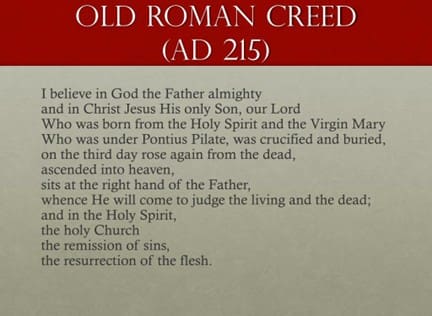
- The first written creed was the Old Roman creed.
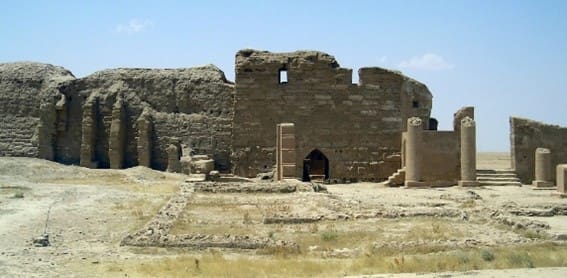
- The oldest archaeological evidence of a building solely built for believers to gather for worship was found in Syria, and dates between 233-256 AD. The ruins of that building still stand.
 |
The weekly recitation of the Apostles’ creed became a part of the “formal” worship services and a prerequisite to baptism for those who received Jesus Christ as their Savior.
|
2. Other Apostolic Creeds –
- The Nicene Creed, written in 325 AD and revised in 381 AD, emphasizes the divinity of Christ.
- The Athanasian Creed, written in the 4th and 5th century, focuses more on the Triune Nature of God.
- The Chalcedonian Creed, also written in the 4th and 5th century, focuses on the dual nature of Christ.
- The Constantinople Creed, which was an expansion of the Nicene Creed, to focus more on the Holy Spirit.
3. Oppositions to the Use of the Creeds –
- The first generation of Baptists, including Southern Baptists, included the texts of both the Apostles; Creed and Nicene Creed in their Confessions of Faith.
- For 1700 years, Baptists also used the Shorter Catechism to train their children in the fundamental issues of theology, which were based on the Westminster or London Confessions of Faith.
- Conservative, Bible-believing and Bible-preaching pastors from Charles Haddon Spurgeon to W.A. Criswell, to Adrian Rogers all recognized the value of using the creeds to teach new Christians. The Confessions of Faith were used to teach “what” we believe, and the Creeds were used to teach “in whom” we believe.
- Then the “cry” came from the liberal elements, “No creed but the Bible,” so they wrote their own statements of faith to show their independence from any authoritarian hierarchy, which is why we are where we are in the church today – we no longer hold churches accountable to doctrinal integrity.
- Christianity is a doctrinal faith and to be a Christian is to learn and live those essential doctrines of the Christian Faith.
- The greatest threat to Christianity today is not persecution from without, but persuasion from within. We are right where Jesus said we would be at the end of the Church age when He said:
“Take heed that no one deceives you, for many will come in My Name, and will deceive many.” (Matthew 24:4-5)
- My goal is to equip you with the basic, but essential truths of the Christian Faith, and your task is to believe them, live them, and share them.