In Search of the Old Paths
“I Believe in Jesus Christ,
Who Suffered under Pontius Pilate,
Was Crucified, Dead, and Buried”
Matthew 27:1-2, 32-60
Wayne J. Edwards, Pastor
The four gospels were written to four specific groups of people, to convince them that Jesus was the Messiah, the God-sent Savior.
- Matthew was written to the Jews to affirm that Jesus fulfilled every Old Testament prophecy regarding the Messiah.
- Mark was written to the Gentiles who had embraced Jesus as the Suffering Servant.
- Luke was written to upper-class Gentiles, such as Theophilus, to verify the historical account of Jesus’ life, death, and resurrection to establish certainty about the faith.
- John was written for a universal audience of both Jews and Gentiles, to establish Jesus as the Christ, the Son of God, i.e., to confirm His deity, that He was sent into the world by God the Father to give His life as a ransom for our sins.
However, the main focus of each of the four gospels is the final week of Jesus’ life.
- About one-third of Matthew, Mark, and Luke, and about half of the gospel of John, focus on Jesus’ final week, from His triumphal entry into the City of Jerusalem to His crucifixion, death, burial, physical resurrection, and ascension.
- Likewise with the Apostle’s Creed – the writers focused on the core doctrine of the Christian faith – “I believe in Jesus Christ, His only Son our Lord, who was conceived by the Holy Ghost, (and) born of the Virgin Mary, (to) He suffered under Pontius Pilate, was crucified, dead and buried.”
- In 2 Corinthians 5:19, the Apostle Paul wrote: “God was in Christ reconciling the sinful world to Himself.”
1. The Redemption Achieved by our Lord’s Suffering and Crucifixion – Matthew 27:1-2 – “When morning came, all the chief priests and elders of the people plotted against Jesus to put Him to death. And when they had bound Him, they led Him away and delivered Him to Pontius Pilate, the governor.”
While the suffering referred to in the Apostles Creed refers to the events leading up to, and including His crucifixion, there is a sense in which the Lord Jesus began to suffer the moment He left His Father’s throne.
- He suffered degradation when He left heaven, which was filled with holiness, and entered earth, which was filled with evil.
- He suffered humiliation when He was born to two teenagers who were among the poorest of the poor, in a dingy cave that served as a stable for animals, and laid in a rock-hewn feed trough.
- He suffered trepidation as He was held by His mother while she rode a donkey for the six-day, 100 – mile journey to Egypt to save His life.
But the Apostle’s Creed does not dwell on that surface level of the Lord’s suffering, but rather focuses on His suffering under Pilate.
- In Isaiah 53:6, the prophet wrote: “All we like sheep have gone astray; we have turned everyone to his own way, and the Lord hath laid on Him the iniquity of us all.”
- In 1 Peter 3:18, the Apostle wrote: “For Christ also suffered once for sins, the just for the unjust, that He might bring us to God, being put to death in the flesh, but made alive by the Spirit.”
- It is humbling to realize that Jesus did not suffer any more than we deserved for our sins.
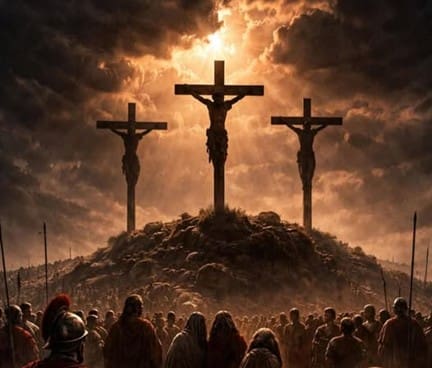
Jesus was crucified on a charge of blasphemy by the Jewish Sanhedrin, for He claimed equality with God. However, to justify His crucifixion, the Romans charged Him with sedition; He claimed to be the King of the Jews, which was a direct challenge to Caesar.
- However, as Peter said on the Day of Pentecost, the crucifixion of Jesus was not a tragedy; it was a necessity, for this was all according to God’s plan for our redemption.
- On the cross, God treated the Lord Jesus as if He had lived our lives with all of our sin, so that God could treat us as if we had lived like the Lord Jesus, who knew no sin.
- But the horror of the cross was not just His physical pain. When Jesus became the object of the Father’s wrath and was cut off from His Father, He cried out, “My God, My God, why have You forsaken Me?”
- That Jesus was the object of God’s wrath on our behalf is known as the Penal Substitutionary Atonement; Jesus bore the divine judgment and punishment for our sins, and to omit it or to neglect it is to abandon the core of the very gospel itself, which is the basis for the “cheap grace” being proclaimed in many pulpits today.
2. The Redemption Secured by the Lord’s Death and Burial – Matthew 27:57-60 – “Now when evening had come, there came a rich man from Arimathea, named Joseph, who himself had also become a disciple of Jesus. This man went to Pilate and asked for the body of Jesus. Then Pilate commanded the body to be given to him. When Joseph had taken the body, he wrapped it in a clean linen cloth, and laid it in his new tomb which he had hewn out of the rock; and he rolled a large stone against the door of the tomb, and departed.”
- After the Lord’s six hours of suffering, and with Pilate’s permission, Joseph of Arimathea had Jesus’ body removed from the cross, wrapped it in a clean linen cloth, and laid in his own tomb.
- Jesus was crucified for sins He did not commit, and placed in a tomb that belonged to us, for our sins were laid upon Him. However, when Jesus came out of that tomb three days and three nights later, our sins were gone forever.
- Isaiah 44:22 – “I have blotted out, like a thick cloud, your transgressions, and like a cloud, your sins.”
- Jeremiah 31:34 – “I will forgive their iniquity, and their sin I will remember no more.”
- Isaiah 38:17 – “You have cast all my sins behind Your back.”
- Micah 7:19 – “You have cast our sins into the depths of the sea.”
In Christian theology, Jesus is understood as the ultimate “scapegoat,” who stood in our place, bore our sins, and took them far away. This concept is rooted in the Old Testament Day of Atonement (Yom Kippur).
- In Leviticus 16, the High Priest symbolically took all the sins of the people, laid them on the head of a goat, and then drove the goat into the wilderness to “take their sins away.”
- As the innocent sacrifice, Jesus willingly took upon Himself the guilt, shame, and punishment for humanity’s sins, effectively removing them from the sinner; He bore the “curse” of sin, which was symbolized by the crown of thorns, and was cast outside the city gates, mirroring the scapegoat driven into the wilderness.
- The only way we can “lay our sins upon Jesus,” is to confess them unto the Lord, and repent to all those affected by our sins, including restitution and reconcilation, where possible.
There was nothing clean about the cross. Today’s Christians have turned it into jewelry, made it small enough to hang around our necks, polished it, and made it so weightless we hardly know we are wearing it.
- But the cross was not safe; it was brutal. It was the place where:
- The Lord’s flesh was torn open by whips until muscle and bone were exposed, and a crown of thorns was driven into His scalp.
- Five to nine-inch square-shaped spikes were hammered into the Lord’s wrists and ankles, pinning the Creator to the very wood He had spoken into being, and by those He was dying to save.
- Every breath was a decision between excruciating pain and suffocation, for to inhale, Jesus had to push against the spikes in His ankles – pain with every inhale, agony with every exhale.
Sin is not small or harmless; sin is cosmic treason against a holy God, and a holy God cannot just pretend it does not exist, or that it did not happen, and as it says in Hebrews 9:22, “Without the shedding of blood, there is no remission of sins.”
Forgiveness was not free; it was paid for, and Jesus paid it all, “For God so loved the world that He gave His only begotten Son, that whosoever believes in Him should not perish but have everlasting life.”
God did not send an angel or a prophet; He sent His only begotten Son, and while Jesus was born to die, He was not forced to die: he lovingly laid down His life in obedience to God the Father.