Old Testament Reading – Psalm 133:1-3
New Testament Reading –Ephesians 4:1-16
In Search of Old Paths
“I Believe in the Communion of the Saints”
Wayne J. Edwards, Pastor
The ninth statement in the Apostle’s Creed reads, “I believe in the holy catholic church: the communion of the saints.”
- The word “catholic” does not refer to the Roman Catholic Church, but rather to the Universal Church; people of every tongue, tribe, and nation; people of every age and generation; all those who have, or will receive Jesus Christ as their Savior and Lord from A.D. 33 until the Rapture of the Church.
- “The communion of the saints” refers to the saints of all ages; both living and dead, united in one body by their expressed faith in Jesus Christ as their Savior and Lord, who, then, share a sacred spiritual bond, being chosen by God, called out by, and filled with the Holy Spirit, to be the very Bride of Christ
- Most scholars consider “the communion of the saints” to be the definition of the one, true church of the Lord Jesus Christ; which He established in A.D. 33, and built on the apostolic doctrines of the Christian faith, including the Triune nature of God, the dual nature of Christ, that He died for the sins of those who believed in Him, and then raised from the grave to validate His deity, which is the Apostolic gospel.
None of today’s churches can trace their historical roots back to that first Church in Jerusalem, which means none can honestly say that Jesus founded their church.
- Jesus found only one Church, and that happened in A.D. 33, in Jerusalem, Israel, as the Jews were observing Pentecost.
- All of the major denominations and non-denominational churches started over 1,000 years later, with the last 15 denominations and/or churches being founded in the last 100 years.
- According to Acts 11:26, the followers of Jesus were first called “Christians” at Antioch, around A.D. 40.
- The earliest followers of Jesus were not called Christians, but rather they were referred to as “disciples,” “believers,” “The Way, or The Way of the Lord.” (Acts 9, 19, and 22)
- To be a true “follower” of Jesus, and to continually enjoy the blessings of God, one must give up their “old way” of life, and walk in the “new way” of life; walking with the Lord in the light of His Word.
The Catholic Church was first recorded by St. Ignatius of Antioch in circa 107–110 AD. The Church as a distinct, organized institution with a centralized Roman papacy took shape after the Edict of Milan in 313 A.D. Protestantism: A diverse tradition that originated in the 16th-century Reformation, emphasizing salvation by faith alone. Major denominational families include: Lutheran, Reformed/Calvinist, Presbyterian, Anglican/Episcopalian, and Congregational. Later movements such as Baptists, Quakers, and Methodists also trace their foundational roots to the theological principles established during this era. Pentecostals, The Assembly of God, and Holiness churches began in the 1900’s, with the non-denominational churches starting in the 1990’s. All of these movements were established by men.

- When the writers of the Apostle’s Creed referred to “the holy catholic or universal church,” they were not referring to any of the churches today, whose membership includes both believers and unbelievers, but rather to “the communion of the saints,” all those who have, or will receive Christ as their Savior from Pentecost to the Rapture.
Some denominations believe this clause validates their belief in the intercession of the glorified saints in heaven, that we can ask them to pray for us or to intercede on our behalf before God the Son and God the Father.
- None of that can be validated in the Scriptures. All of it has been added to the tenets of the Christian Faith by the Roman Catholic Church and the Eastern Orthodox Church.
- I. Packer, the distinguished author of “Knowing God,” said:
- “The communion of the saints confirms the real union in Christ of the Church militant here on earth; i.e., those believers who are still in a spiritual battle against sin, temptation, and the forces of evil, with the Church triumphant in glory, those who fought the good fight and have achieved their position of victory in Jesus.”
1. The Believer’s Communion with God – Philippians 3:7-11 – Vss. 10-11 – “That I may know Him and the power of His resurrection, and the fellowship of His sufferings, being conformed to His death, if, by any means, I may attain to the resurrection from the dead.”
- Some claim to be Christians who only know God in the flesh; they know about Him.
- Others know God through their souls; they acknowledge His existence, they have a mental agreement with the life and ministry of Jesus Christ, and, in their own way, they love God and try to please Him.
- But it is only through our spirit that we can have true communion with God. As Jesus told Nicodemus, to have that level of intimacy with a holy God, we must be born again, not of the flesh, but of the Holy Spirit, for that is to have a true, saving knowledge of God.
- Therefore, the definition of a Christian is that person whose communion with God has been restored through their expressed faith in Jesus Christ, having been born again by, and then filled with the Holy Spirit.
- “Now may the God of peace Himself sanctify you completely; and may your whole spirit, soul, and body be preserved blameless at the coming of our Lord Jesus Christ. He who calls you is faithful, who also will do it.” (1 Thessalonians 5:23)
- The Apostle Paul said he would not be satisfied with anything less than that continual communion with the Lord Jesus, even if he had to endure the same physical suffering as Jesus did to experience it.
2. The Believer’s Unity with the Church Triumphant – Hebrews 12:22- 23 – “You have come to Mount Zion and to the city of the living God, the heavenly Jerusalem, to an innumerable company of angels, to the general assembly and the church of the firstborn who are registered in heaven, to God the Judge of all, to the spirits of just men made perfect.”
- The writer of Hebrews is telling us that, not only can believers on earth have communion with one another, but, at some level, we can also have communion with saints in glory; for we are part of the same body, the universal Church, the Body of Christ.
- Even though we do not know their specific duties around the throne of God, when believers assemble for corporate worship, we are doing the same thing they have been, and will be doing until we join with them in heaven, and return to this earth with the Lord Jesus: we are praising the Lord and giving Him glory!
3. The believer’s Unity with Other Believers on Earth – 1 Corinthians 12:7 – “But the manifestation of the Spirit is given to each one for the profit of all.”
- Spirit-filled believers are in communion with all other believers, which means we must not use our God-given spiritual gifts to draw attention to ourselves, but rather as our means of ministry to the church body.
- 1 Corinthians 12: 12-14: “For as the body is one and has many members, but all the members of that one body, being many, are one body, so also is Christ. For by one Spirit we were all baptized into one body—whether Jews or Greeks, whether slaves or free—and have all been made to drink into one Spirit. For in fact the body is not one member but many.”
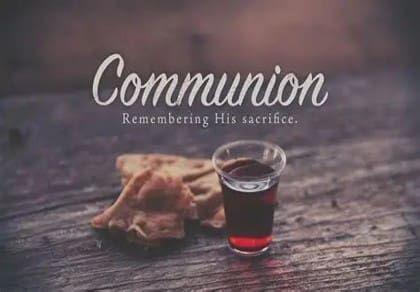
- This morning, as we observe the Lord’s Supper, which is also called “Holy Communion,” we all share a portion of the same bread, which represents the body of Christ, which was broken for us, and a portion of the same fruit of the vine, which represents the blood of Christ, which was shed for us. And in so doing, we also are in communion with God, who has made it possible for us to draw near to Him; to commune with Him, as Moses did, “face to face, and friend to Friend.” (Exodus 33:11)