Old Testament Reading – Deuteronomy 7:1-8
New Testament Reading – 2 Corinthians 6:11-18
Victorious Christian Living
“Stepping Forward in Faith”
Joshua 16:1-17:18
Wayne J. Edwards, Pastor
Chapters 1-13 of the Book of Joshua focus on the conquest of the land of Canaan – how Joshua led the Israelites to cross over the Jordan River and into the land God promised Abraham, and then, over the next seven years, how Joshua led the Israelites to victory in 13 key battles, and defeating over 30 Canaanite kings to conquer the land.
- Chapters 14-24 focus on the division and allotment of the land among the twelve tribes of Israel, as well as Joshua’s farewell address to the nation.
- Two-and-a-half tribes received their inheritance on the eastern side of the Jordan River under the authority of Moses, and now the other nine-and-a-half tribes are receiving their allotment as well.
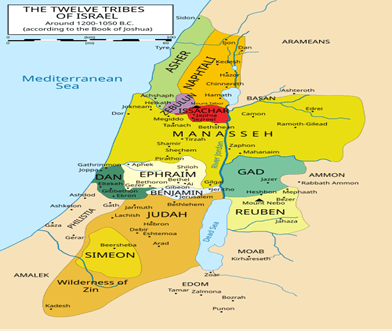
- According to Joshua 15:1-12, the boundaries of Judah’s inheritance stretched from the southernmost point at the border of Edom to the northern boundary near Jerusalem. The eastern boundary was the Dead Sea, while the western boundary reached the Mediterranean Sea.
- The inheritance of the Tribe of Joseph is unique in that it is divided between Ephriam and Manasseh, the sons of Joseph, whom Jacob adopted as his own sons.
- Ephraim’s Inheritance: The territory of Ephraim included the central portion of the land, bordered by the Jordan River to the east and extending westward.
- Manasseh’s Inheritance: The half-tribe of Manasseh received a large inheritance that was divided into two parts: one on the west side of the Jordan River and the other on the east.
- In the 18th chapter of Joshua, the Israelite congregation gathered at Shiloh, where they established the Tent of Meeting. Joshua addressed the seven tribes that had not received their inheritance.
- The chapter explicitly outlines the inheritance of the tribe of Benjamin, and reiterates that the Levites did not receive a land inheritance, but rather the priesthood of the Lord Himself.
In his book, “Mere Christianity,” C.S. Lewis wrote:
- “Both good and evil increase at compound interest. That is why the little decisions we make every day are of such infinite importance. The smallest act of good today is the capture of a strategic point from which a few months later we may be able to go onto victories we never dreamed of. Likewise, what may appear as a trivial indulgence in lust or anger today is the loss of a ridge or railway line or even a bridgehead from which the enemy may launch an attack which would have otherwise been impossible.”
- Matthew 6:19-21 “Do not lay up for yourselves treasures on earth, where moth and rust destroy and where thieves break in and steal; but lay up for yourselves treasures in heaven, where neither moth nor rust destroys and where thieves do not break in and steal. For where your treasure is, there your heart will be also.
- Romans 2:5 – “But in accordance with your hardness and your impenitent heart you are treasuring up for yourself wrath in the day of wrath and revelation of the righteous judgment of God.”
Three examples of increasing failure on the part of the tribes of Israel.
- Joshua 15:63 – “But the Jebusites, the inhabitants of Jerusalem, the people of Judah could not drive out.”
- Joshua 16:10 – “However, they did not drive out the Canaanites who lived in Gezer, so the Canaanites have lived in the midst of Ephraim to this day but have been made to do forced labor.”
- Joshua 17:12 – “Yet the people of Manasseh could not take possession of those cities, but the Canaanites persisted in dwelling in that land.”
- Notice how the seriousness of each failure increased.
- With Judah and Ephriam, it was just one city, but with Manasseh, it became “many cities.”
- Notice how the effort of each tribe decreased.
- Judah tried and failed.
- Ephriam did not even try.
- Manasseh had the power to do it, but rather than destroy the Canaanites, or at least run them out of the city, “they chose” to put the people into slavery – a ‘half-obedience’ to God’s command.
- In Joshua 17:14, Ephriam and Manasseh questioned Joshua, saying: “Why have you given us only one lot and one share to inherit, since we are a great people, inasmuch as the Lord has blessed us until now?”
- In Joshua 17:15, Joshua answered them: “If you are such a great people, then go up to the forest country and clear a place for yourself there in the land of the Perizzites and the giants, since the mountains of Ephraim are too confined for you.”
Ingratitude is the first step towards disobedience.
- When a person has an ungrateful heart, they are on their way to a life of disobedience, and if that isn’t checked, they will remain on the handout line for the rest of their lives. They will always expect someone to provide for them that which they are not willing to work for themselves, and they will never be satisfied with what others do for them.
- Rather than being thankful for God’s goodness in giving them their allotment, the tribe of Manaasseh questioned God’s wisdom! Since they were a blessed people, they deserved more.
- In Deuteronomy 7, God told the Israelites: “You shall not be terrified of them; for the Lord your God, the great and awesome God, is among you. And the Lord your God will drive out those nations before you little by little; you will be unable to destroy them at once, lest the beasts of the field become too numerous for you. But the Lord your God will deliver them over to you, and will inflict defeat upon them until they are destroyed.”
- In Exodus 23 and Exodus 34, God told the Israelites to not let the Canaanites stay in their midst, for He knew they would lead the Israelites away from their worship of Him.
- You shall make no covenant with them.
- You shall show no mercy to them.
- You shall not intermarry with them.
- You shall not give your daughters to their sons, or your sons to their daughters, for they will turn your sons away from Me to serve other gods.
- But, even after seeing, or at least hearing about what God had done for their fathers and forefathers, they failed to take God at His Word and fully remove that which God knew would cause them to stumble, and their root of disobedience was manifested in their children and in their children’s children.
- Judges 1:21 – “But the children of Benjamin did not drive out the Jebusites who inhabited Jerusalem, so the Jebusites dwell with the children of Benjamin in Jerusalem to this day.”
- Judges 1:27 – “Manasseh did not drive out the inhabitants of Beth Shean and its villages, or Taanach and its villages, or the inhabitants of Dor and its villages, or the inhabitants of Ibleam and its villages, or the in habitants of Megiddo and its villages, for the Canaanites were determined to dwell in that land.”
- Judges 1:28 – “They put the Canaanites under tribute, but did not completely drive them out.”
- Judges 1:29 – “Nor did Ephraim drive out the Canaanites who dwelt in Gezer.”
- Judges 1:30 – Nor did Zebulun drive out the inhabitants of Kitron or the inhabitants of Nahalol, so the Canaanites dwelt among them, and [h]were put under tribute.:
- Judges 1:31-32 – Nor did Asher drive out the inhabitants of Acco or the inhabitants of Sidon, or of Ahlab, Achzib, Helbah, Aphik, or Rehob. So, the Asherites dwelt among the Canaanites, the inhabitants of the land; for they did not drive them out.”
- Judges 1:33 – Nor did Naphtali drive out the inhabitants of Beth Shemesh or the inhabitants of Beth Anath; but they dwelt among the Canaanites, the inhabitants of the land. Nevertheless, the inhabitants of Beth Shemesh and Beth Anath were put under tribute to them.”
- Judges 1:34-35 – “And the Amorites forced the children of Dan into the mountains, for they would not allow them to come down to the valley, and the Amorites were determined to dwell in Mount Heres, in Aijalon, and in Shaalbim; yet when the strength of the house of Joseph became greater, they were put under tribute.”
- The Israelites disobeyed God! They did not even drive them out of the cities, much less completely destroy them.
- Even though it was hundreds of years later, those two sinful seeds of laxity and lethargy, which seemed so right at the time, led them right back into captivity.
- Judges 2:11 – “Then the children of Israel did evil in the sight of the Lord, and served Baals.”
In Joshua 24, Joshua reminded the people: “I have given you a land for which you did not labor, and cities which you did not build, and you dwell in them; you eat of the vineyards and olive groves which you did not plant. Now therefore, fear the Lord, serve Him in sincerity and in truth, and put away the gods which your fathers served on the other side of the river and in Egypt. Serve the Lord! And if it seems evil to you to serve the Lord, choose for yourselves this day whom you will serve, whether the gods which your fathers served that were on the other side of the river, or the gods of the Amorites, in whose land you dwell. But as for me and my house, we will serve the Lord.”
In Judges 2:12ff, “And they forsook the Lord God of their fathers, who had brought them out of the land of Egypt; and they followed other gods from among the gods of the people who were all around them, and they bowed down to them…So, He delivered them into the hands of plunderers who despoiled them; and He sold them into the hands of their enemies all around, so that they could no longer stand before their enemies. Wherever they went out, the hand of the Lord was against them for calamity, as the Lord had said, and as the Lord had sworn to them. And they were greatly distressed.”
- To be distressed means to be troubled, distraught, upset, unhappy, and deeply afflicted.
- If we become distressed over temporal things:
- In 1 Peter 5:7, the Apostle urged us to “Cast all our cares on the Lord, for He cares for us.”
- In Philippians 4:6 –7, the Apostle said we should not be “Anxious about anything, but in every situation, by prayer, with thanksgiving, make our requests known to God, and the peace of God, which transcends our understanding will guard our hearts and our minds through Christ Jesus.”
- If we become distressed over spiritual things:
- A true confession of sin requires more than the verbalization of the words; it demands our acknowledgement that our sin was not a mistake or a bad choice, but rather it was an act of rebellion against God.
- True repentance demands that we turn from that sin and start walking in obedience to God, including seeing reconciliation and making restitution with those who were affected by our sins.