Victorious Christian Living
“Finding Refuge in God’s Justice and Mercy”
Joshua 20:1 – 21:45
Wayne J. Edwards, Pastor
The term “refuge” is seldom used in today’s vocabulary, but in the days of the Bible, a “refuge” described a place of safety from danger and distress. For thousands of years, that was limited to the cleft of rocks, dens, and caves.
- The writers of the Old Testament, and especially the psalms, used this analogy to describe God as their refuge; their ever-present help in times of trouble.
- What the cave was to them in the face of physical danger, God was to them in the face of His eternal condemnation for their sins.
- Psalm 91:1-2: “He who dwells in the shelter of the Most High will abide in the shadow of the Almighty. I will say to the Lord, ‘My refuge and my fortress, my God, in whom I trust.”
- Psalm 16:1, “Protect me, God, for I take refuge in you.”
- In John 3:16, the Apostle had this in mind when he wrote, “For God so loved the world that he gave his only begotten Son, [as a place of refuge for sinners,] that whosoever believed in him should not perish but have eternal life”
- In John 5:24, Jesus said: “He that heareth my word, and believeth on him that sent me, hath everlasting life, and shall not come into condemnation; but is passed from death unto life”
- Jesus is our refuge from an eternity in hell.
The first 12 chapters of the Book of Joshua describe how, under God’s leadership, Joshua led the Israelites to take possession of the land of Canaan, as the fulfillment of God’s promise to Abraham and his descendants as an “everlasting possession.”
- In Chapters 13-21, Joshua describes how, under God’s divine direction, the land of Canaan was divided between the 12 tribes.
- The Levites were the only tribe not given an allotment of land, because their inheritance was God Himself, as they were to serve as priests and temple servants for all of the people of Israel.
- Nevertheless, they needed a place to live, so God made provision for them within the territories of the other tribes.
- In chapter 20, God designated six cities to be Levitical cities, which would also serve as cities of refuge, where someone who had caused the unintentional death of another person could find protection until their case could be adjudicated.
- In chapter 21, Joshua lists the locations of the six cities of refuge, given to the Levites according to their various clans.
1. The Lord is a Just Judge – Joshua 20-21
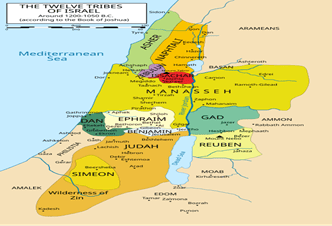
- Six cities were set apart as Cities of Refuge:
- Kadesh in Galilee, Shechem in Ephriam, Hebron in Judah, Bezer in Reuben, Ramoth in Gilead, and Golan in Bashan, from the tribe of Manasseh.
- Forty-eight cities and pasturelands were given to Levites from the territories of the other 12 tribes.
- The families of the Kohathites were responsible for all the items of the tabernacle: the ark, the table, the lampstand, the altars, the curtain, and everything related to their use. This clan, who were descendants of Aaron, received their land from the tribes of Judah, Simeon, Benjamin, Ephraim, Dan, and the half-tribe of Manasseh, for a total of 23 cities and pasturelands.
- The families of the Gershonites were responsible for the transport of the tabernacle’s coverings and curtains through the wilderness. The Gershonites received their lands from the tribes of Issachar, Asher, Naphtali, and the half-tribe of Manasseh in Bashan, totaling 13 cities and pasturelands.
- The families of Merarite guarded the tabernacle and transported its boards and pillars through the wilderness. They were given land from the tribes of Reuben, Gad, and Zebulun, totaling 12 cities and pasturelands.
- Joshua 21:41 – “All the cities of the Levites within the possession of the children of Israel were forty-eight cities with their common-lands.
- Joshua 21:43-45 – “So, the Lord gave to Israel all the land of which He had sworn to give to their fathers, and they took possession of it and dwelt in it. The Lord gave them rest all around, according to all that He had sworn to their fathers. Not a man of all their enemies stood against them; the Lord delivered all their enemies into their hands. Not a word failed of any good thing which the Lord had spoken to the house of Israel. All came to pass.”
- The same sovereign God who destroys His enemies is also the God who provides refuge for those who seek His mercy.
2. The Lord is a Good Shepherd – Josuah 21:1-3
- The most important part of this provision of land for the Levites is that none of the cities were clustered together in a territory they could claim as their own allotment, but rather they were scattered over the land of Israel in the territories that were already allocated to the other tribes, so that in every tribal region, there would always be a Levite nearby.
- The Levites were priests; they were teachers of the Word of God; in effect, they were the shepherds of God’s flock.
- God scattered His shepherds so the 2.5 million people could have personal access to someone who could teach the Word of God and care for the people.
- In John 21:15-19, Jesus exhorted Peter three times, if he truly loved Him, he should: “Feed My lambs, Tend My sheep, and Feed My sheep.”
- In 2 Peter 5:2, Peter proved he had heard the word of the Lord that morning, for in his epistle, he warned those who were serving as pastors: “Shepherd the flock of God that is among you, exercising oversight, not under compulsion, but willingly as God would have you; not for shameful gain but eagerly, not domineering over those in your charge, but as examples to the flock.”
- In Acts 20:28, the Apostle Paul put it this way: “Pay careful attention to yourselves and to all the flock in which the Holy Spirit has made you overseers to care for the church of God which He obtained with His own blood.”
3. The Lord is a Faithful Promise Keeper – Joshua 21:43-45
- John 21:45 – “Not a word failed of any good thing which the Lord had spoken to the house of Israel. All came to pass.”
- Joshua, or his amanuensis, broke out in a doxology of praise unto God for His faithfulness to His people. The conquest of Canaan was over, and the people could finally rest.
- Theologians refer to this as a “Dynamic Certainty.” Because God said it would happen, those who wrote the Scriptures could speak as though it had already happened, even though the event would still be in the future.