THE WATCHMEN’S REPORT
NEWS STORIES THAT CONNECT WITH BIBLICAL PROPHECY
BY Wayne J. Edwards, September 30, 2026
AI AND THE COMING ARGUMENT
FOFR A ONE-WORLD GOVERNMENT
PNW STAFF, SEPTEMBER 29, 2026

For generations, Christians reading biblical prophecy have wrestled with a basic practical question: How could the nations of the world ever surrender enough sovereignty for anything resembling a truly global system of government to emerge? Perhaps the answer isn’t that humanity will suddenly fall in love with global government. Perhaps humanity will become afraid of something it believes only global government can control. That possibility has become considerably more interesting as artificial intelligence races forward. And billionaire technology investor Peter Thiel–who has spent considerable time publicly discussing the Antichrist, Armageddon and the dangers of global governance–has now made a striking observation.
Asked by Mathias Döpfner what it would actually take to slow the international AI race, Thiel said meaningful restraint would require extraordinary worldwide cooperation. “In theory, you could slow it down if you had genuine, deep cooperation across the whole world,” Thiel said. But then came the important part. Such cooperation, he argued, would require something resembling “a one world government with real teeth, real force.” Thiel immediately warned that such a solution could be worse than the problem itself. That should get our attention. Because AI may be creating something historically unusual: a global problem that governments eventually conclude cannot be solved by national governments. And here is the deeper danger. AI could simultaneously create the crisis used to justify global government–and provide the technological machinery necessary to operate it.
The Problem No Country Can Solve Alone
Imagine Washington decides tomorrow that advanced AI development has become too dangerous. America imposes strict limits on computing power, advanced chips and AI training. What happens if China doesn’t? Or Russia? Or another country? Or a private organization operating beyond American jurisdiction? The competitive pressure becomes enormous. No major power wants to stop developing a technology that could determine future military superiority, intelligence capabilities, economic dominance and scientific advancement while its rivals continue racing ahead. Thiel himself raised essentially this problem. Western restrictions could simply leave competitors–particularly China–continuing their development. That means genuinely stopping or significantly slowing AI would require more than American legislation. It would require global cooperation. But cooperation isn’t enough if countries can cheat. Eventually someone must inspect. Someone must monitor. Someone must enforce. And suddenly the discussion has moved from international cooperation toward international authority. That is precisely where Thiel’s phrase becomes so important: a global authority with “real teeth” and “real force.”
The Crisis Changes. The Argument Remains
Humanity has already heard versions of this argument. Climate change crosses borders. Pandemics cross borders.
Nuclear weapons threaten everyone. Financial crises spread internationally. Biological weapons could affect the entire planet. And now artificial intelligence may eventually present another version of the same proposition: the threat is global, therefore the solution must also be global. But AI is different in one particularly important respect. The technology needed to monitor AI could create an infrastructure capable of monitoring humanity itself.
Consider what serious global AI enforcement might eventually require. Authorities could demand knowledge of who possesses advanced processors, where massive computing clusters are operating, what models are being trained, how much computing power organizations possess and whether companies or governments are secretly developing prohibited systems. That could require unprecedented visibility into data centers, communications networks, financial transactions, semiconductor supply chains and digital infrastructure. Now combine that with increasingly sophisticated AI surveillance. Facial recognition. Digital identity. Automated financial monitoring. Behavioral analysis. Massive databases. Algorithmic censorship. Predictive policing. Centralized digital payment systems.
None of these technologies independently constitutes the prophetic system described in Revelation. Christians should be careful about declaring every technological development the fulfillment of a particular prophecy.
But neither should we ignore what is happening before our eyes.
The technological architecture necessary for extraordinary centralized control is becoming increasingly conceivable.
Thiel Has Been Warning About This For Years
What makes Thiel’s latest remarks particularly fascinating is his previous discussion of the Antichrist. In his public conversations and 2025 lectures, Thiel explored the possibility that fear of existential catastrophe could become the justification for unprecedented global political authority. His framework presents a disturbing dilemma. Humanity becomes terrified of Armageddon–nuclear war, runaway technology, biological catastrophe or some other existential threat–and eventually accepts enormous centralized power from whoever promises to prevent it. In other words, global government doesn’t necessarily arrive because humanity suddenly embraces the idea. It arrives because humanity becomes convinced that the alternative is catastrophe.
That possibility should sound familiar to students of biblical prophecy. Revelation describes a future system possessing extraordinary political and economic control. Revelation 13 famously describes a system in which participation in economic life–buying and selling–becomes connected to allegiance to the Beast. For most of history, people could understand the theological warning while struggling to imagine the practical mechanics. How could any authority monitor billions of people? How could economic participation actually be controlled? How could individuals scattered across continents be identified, tracked and restricted? Those questions are becoming easier to answer.
AI Could Be Both The Emergency And The Enforcement System
This is perhaps the most important point. Usually the crisis and the mechanism used to address the crisis are separate.
AI may be different. Imagine sufficiently advanced artificial intelligence begins producing increasingly frightening consequences: autonomous cyberattacks, sophisticated biological threats, destabilized labor markets, military escalation, financial disruption, deepfake-driven political chaos or autonomous weapons operating faster than humans can control them. Public fear would understandably increase. Governments would respond. But if national regulation repeatedly failed because AI development continued elsewhere, pressure for international enforcement would grow.
Then comes the extraordinary irony. What technology would be best suited to monitor such a gigantic global regulatory system? Artificial intelligence. AI could analyze financial activity. AI could monitor communications. AI could identify prohibited computing clusters. AI could track individuals. AI could detect unauthorized transactions. AI could monitor borders. AI could identify political or security threats. AI could process surveillance data at a scale impossible for human bureaucracies. The very technology that creates demands for unprecedented global governance could also make unprecedented global governance technically possible. That is a development worth contemplating. Previous generations could dream about world government, but administering billions of human beings was extraordinarily difficult. AI changes the equation. For the first time, humanity is building machines capable of analyzing enormous populations, transactions, communications and behavioral patterns continuously and automatically. A global control system that once required millions of bureaucrats could increasingly be administered by algorithms.
The Antichrist Doesn’t Have To Sell Tyranny
Christians sometimes imagine the future Antichrist arriving openly declaring his intention to dominate humanity. But deception rarely works that way. Control is easier to accept when it is presented as protection. Surveillance becomes safety. Censorship becomes protection from misinformation. Financial monitoring becomes protection against crime.
Digital identification becomes convenience and security. International enforcement becomes protection against existential catastrophe. And centralized authority becomes the price humanity is told it must pay to survive. That does not mean every person advocating international AI cooperation secretly desires world government. There are legitimate reasons for governments to discuss safeguards around technologies capable of affecting civilization. The prophetic question is what happens when cooperation is declared insufficient. What happens when voluntary agreements fail? What happens when one country refuses? What happens when an AI disaster finally occurs? The demand may quickly become: Someone must have the authority to enforce the rules. And whoever possesses that authority would wield extraordinary power.
A Warning Worth Hearing
Peter Thiel isn’t a prophet, and his political and theological interpretations should not be treated as Scripture. But his observation exposes a question Christians should consider carefully. What kind of crisis could convince independent nations to surrender powers they would never surrender under normal circumstances? AI may provide one possible answer. Not because someone announces a grand plan for world government, but because governments gradually conclude that technology has become too dangerous to regulate separately. The world may eventually be presented with an extraordinarily persuasive argument: Either humanity establishes powerful global mechanisms capable of controlling artificial intelligence–or humanity risks losing control of artificial intelligence altogether. And once that argument takes hold, the debate will no longer be about whether global authority is desirable. It will be about whether global authority is necessary. That is the moment students of prophecy should be watching.
Because perhaps the greatest danger isn’t that someone will someday force humanity into a global system. It is that humanity may become frightened enough to demand one. And AI may not merely provide the crisis that makes such a demand possible. It may provide the machinery that makes such a system possible as well.
The Beast from the Earth – Revelation 13:12-18 NKJV
11 Then I saw another beast coming up out of the earth, and he had two horns like a lamb and spoke like a dragon. 12 And he exercises all the authority of the first beast in his presence, and causes the earth and those who dwell in it to worship the first beast, whose deadly wound was healed. 13 He performs great signs, so that he even makes fire come down from heaven on the earth in the sight of men. 14 And he deceives [f]those who dwell on the earth by those signs which he was granted to do in the sight of the beast, telling those who dwell on the earth to make an image to the beast who was wounded by the sword and lived. 15 He was granted power to give breath to the image of the beast, that the image of the beast should both speak and cause as many as would not worship the image of the beast to be killed. 16 He causes all, both small and great, rich and poor, free and slave, to receive a mark on their right hand or on their foreheads, 17 and that no one may buy or sell except one who has [g]the mark or the name of the beast, or the number of his name. 18 Here is wisdom. Let him who has understanding calculate the number of the beast, for it is the number of a man: His number is 666.
WHISTLEBLOWER SPECIAL REPORT
AMERICA’S ULTIMATE WAR
POWERFUL FORCES ATTACKING THE WORLD’S MOST CHRISTIAN NATION AREN’T MERELY POLITICAL AND IDEOLOGIAL
THEY ARE INSANE AND DEMONIC
WND STAFF, SEPTEMBER 29, 2026

Recently, some of America’s most widely respected Christian leaders have sounded the exact same spine-straightening alarm:
- Franklin Graham: “A storm is coming, and we’d better be ready, because it appears as if all the demons in hell have been turned loose.”
- Ben Carson: “The increasingly irrational nature of America’s political and cultural battles suggests that supernatural forces are playing a role in them.”
- Author/broadcaster Eric Metaxas: “We are in our third existential crisis in America. The first was the Revolution, the second was the Civil War. We are now in our third: We’re dealing with various forces arrayed against the founders’ vision, whether it’s Islamo-fascism or cultural Marxism. They hate liberty. They hate the liberty that you get from the Bible – all of it comes out of the Bible. … The American Left is Satanic.”
Demons? Supernatural forces? Satan?
Consider this: After 250 years, the United States of America, unquestionably the greatest, freest, most successful and most Christian nation in world history, finds itself being rapidly transformed into something unrecognizable … and once unthinkable. Transformed not just by rage, violence and rebellion – that’s all happened before – but by mass delusion and shockingly bizarre political, cultural and spiritual forces openly dedicated to the total annihilation both of America’s form of government and its bedrock Judeo-Christian values.
Almost everywhere one looks, genuine insanity – and yes, evil – can be seen waging war against everything good and decent in America. There are the continual threats and repeated actual attempts to assassinate President Donald J. Trump, whom many absurdly compare to history’s most infamous genocidal psychopath, Adolf Hitler, who murdered 11-17 million innocent people, according to the Holocaust Encyclopedia. There’s the widespread promotion of wildly pathological beliefs about gender identity, causing thousands – that’s correct, thousands – of American children to have their breasts or sexual organs amputated. There’s the “treasonous” (to use Trump’s term) Biden-era policy of having invited and facilitated the full-scale foreign invasion of America, including hordes of convicted murderers and rapists, plus countless child-sex-traffickers, fentanyl dealers, Chinese communist spies, Islamic terrorists and Satan-worshipping (MS-13) gang members. And then there is today’s rapid ascendence of smiling and glib communist (“democratic socialist”) and Islamist politicians, both loyal to worldviews utterly at war with America’s Constitution and Christian culture. In virtually every area of life, bizarre and malignant forces have somehow attained a major stronghold in “the land of the free and the home of the brave.” How? Why?
The new madness evades traditional explanations
Today, the customary paradigms long relied on for explaining America’s political and cultural divisions no longer apply. In previous eras, the major party affiliations “Democrat” and “Republican” meant something, just as their associated ideological labels “liberal” and “conservative” corresponded to comprehensible sets of concerns, values and priorities. But while “conservative” and “Republican” still mean roughly the same as a generation ago, “Democrat” now encompasses an entire spectrum of destructive, corrupt, demented and treasonous agendas, while the word “liberal” is rarely heard anymore, since it no longer fits most of today’s Democrats. (Imagine, for example, the absurdity of describing New York City’s Marxist-Muslim Mayor Zohran Mamdani – who after swearing his oath of office on the Quran went total communist by proclaiming “We will replace the frigidity of rugged individualism with the warmth of collectivism” – as a liberal!)
Those intent on transforming America today aren’t “liberal.”
They’re corrupt, deranged and dangerous.
They claim a man can magically become a woman simply by thinking and believing he’s a woman (and vice versa) … and by amputating a few inconvenient body parts and taking opposite-sex hormones with multiple profound, horrendous and irreversible negative effects.
Meanwhile, all those popular candidates backed by the ever-more-influential Democratic Socialists of America (DSA) insist they want to eliminate America’s police and prisons, abolish the U.S. Senate and the Supreme Court entirely, and even the presidency itself. Oh, and they also insist on allowing everyone to vote in America’s elections, including illegal aliens and convicted criminals.
Think it can’t get any more insane? One candidate for Wisconsin governor, the DSA-backed Francesca Hong, even has a history of publicly calling for the abolition of Thanksgiving and Christmas! Another, William Lawrence, running for a House seat in Michigan, has insisted on a “world without borders,” demanding that America “redistribute all the land and all the money” it has to make up for America’s “evil deeds.” In other words, these people – by any reasonable, reality-based measure – are genuinely stark raving mad.

PNW STAFF, SEPTEMBER 30, 2026
America is entering a period in which several economic warning signs are flashing at the same time. None of them, by itself, proves that a recession or financial crisis is around the corner. In fact, parts of the economy remain remarkably resilient. But taken together, they tell us something important: the financial pressure on American households is becoming increasingly difficult to ignore.
Here are seven warning signs worth watching.
1. Treasury Yields Are Sending A Warning
The bond market rarely makes dinner-table conversation, but perhaps it should. Long-term Treasury yields have recently climbed to levels not seen in decades, with the 30-year yield reaching its highest level since 2004. Why should the average American care? Because Treasury yields influence borrowing costs throughout the economy. Mortgages, business loans and other forms of credit are affected by what happens in the bond market. Higher government borrowing costs also matter because Washington must continually refinance an enormous national debt. The more expensive that becomes, the larger the government’s interest burden becomes. A move in Treasury yields may look like something happening on a trader’s computer screen. Eventually, however, the consequences can reach Main Street.
2. Diesel Has Become Everybody’s Problem
Diesel recently surged above $6 per gallon nationally, hitting record territory. Farmers have been particularly hard hit during one of the most fuel-intensive periods of the year. But this isn’t just a farmer problem. Diesel powers tractors, combines and other agricultural equipment. It powers the trucks transporting produce, meat and dairy products. It moves construction equipment and countless commercial vehicles. In other words, much of the physical economy runs on diesel. When farmers spend dramatically more to harvest crops and truckers spend dramatically more to move them, somebody eventually has to absorb those costs. Businesses can swallow them temporarily, but not indefinitely. That means the diesel price displayed at a truck stop hundreds of miles away may eventually appear in your grocery receipt.
3. America’s Farmers Are Being Squeezed
Diesel isn’t the only problem confronting agriculture. The USDA expects inflation-adjusted net farm income to decline 5.5 percent in 2026. Meanwhile, total farm-sector debt is projected to climb 4.6 percent to approximately $605 billion. Those numbers deserve more attention than they receive. America’s food supply depends upon producers who face many of the same problems households do: higher borrowing costs, higher energy costs and expensive inputs. Farmers cannot simply stop planting or harvesting because diesel, fertilizer or financing became too expensive. They have to make the numbers work. When they can’t, they borrow more, cut expenses, postpone equipment purchases or eventually leave the business. Americans may live hundreds of miles from the nearest farm, but every family visits a grocery store. What happens in farm country doesn’t stay in farm country.
4. Interest Rates Are Moving The Wrong Direction Again
The Federal Reserve raised its benchmark interest rate by a quarter percentage point in September to a range of 3.75 to 4 percent, citing inflation that remains elevated. That is significant because Americans had spent years waiting for relief from high borrowing costs. Instead, inflationary pressure has complicated the picture again. Higher rates make carrying credit-card balances more expensive. They affect auto financing, business loans and adjustable-rate debt. They also make it more difficult for companies to justify expansion and investment. The painful reality is that fighting inflation itself can hurt. If rates remain high because prices remain high, consumers can find themselves trapped between two problems: expensive goods and expensive money.
5. The Housing Affordability Crisis Isn’t Going Away
The average 30-year fixed mortgage reached 7.03 percent in late September, according to Freddie Mac. Consider what that means for an ordinary family. A $400,000 mortgage at 3 percent carries principal and interest of roughly $1,686 per month. At 7 percent, it is roughly $2,661. That’s nearly $1,000 more every month for essentially the same amount of borrowed money. Higher mortgage rates don’t only affect people buying houses. They discourage existing homeowners with low-rate mortgages from moving, distort housing supply, affect construction and make it harder for younger Americans to establish themselves financially. For millions of families, the American dream hasn’t disappeared because houses don’t exist. It has become harder because the monthly payment no longer works.
6. Americans Are Carrying An Enormous Debt Load
U.S. household debt stood at approximately $18.8 trillion at the end of the second quarter. Credit-card balances alone reached $1.26 trillion, while auto-loan balances climbed to $1.71 trillion. Those numbers become particularly important when borrowing costs remain elevated. Debt can disguise financial stress for a while. A household facing higher grocery, insurance, utility and transportation expenses can maintain its lifestyle by putting more purchases on credit. But borrowing doesn’t eliminate the cost. It moves the bill into the future–and adds interest. The New York Federal Reserve says new delinquencies on auto loans and credit cards remain elevated. That doesn’t mean American consumers are collapsing. It does suggest that some households have less room for another economic shock than the headline economic numbers might imply.
7. Consumers Are Losing Confidence
Perhaps the most revealing warning sign is also the simplest: Americans themselves are worried. The Conference Board’s Consumer Confidence Index plunged 6.7 points in September to 81.9–the lowest reading since April 2014. Consumers reported increasing concern about prices, employment prospects and the economic outlook. That matters because consumer spending is a critical engine of the American economy. When families become nervous, behavior changes. They postpone buying the car. They delay remodeling the kitchen. They eat out less frequently. They skip the vacation. They keep the old appliance another year. They begin saving whatever they can because they aren’t certain what comes next. One family’s decision to spend less doesn’t matter much. Millions of families making that decision simultaneously certainly does.
The Real Warning Is That These Problems Are Connected
This is what makes the current situation worth watching. Higher energy costs can contribute to inflation. Inflation can keep interest rates higher. Higher rates can increase mortgage and business borrowing costs. Higher farm and transportation costs can eventually increase consumer prices. Higher household expenses can push families toward credit. And eventually, squeezed consumers begin pulling back. One pressure feeds another. None of this means an economic collapse is inevitable. The labor market, for example, continues to show important signs of resilience, and parts of the economy remain strong. But waiting until a crisis officially arrives before paying attention to warning signs defeats the purpose of watching them.
For most Americans, “the economy” isn’t GDP, Treasury auctions or Federal Reserve statements.
It’s whether the paycheck stretches until Friday.
It’s whether the family can afford the mortgage.
It’s whether filling the truck costs $80 or $140.
It’s whether groceries require another $50 this week.
It’s whether the credit-card balance is going down–or quietly climbing.
And it’s whether a farmer can afford to plant next year’s crop.
That’s why these seven warning signs matter.
They may appear in completely different economic reports,
but eventually they all arrive at the same place: the American household.
_________________________________________________________

THE FALLING AWAY IS ON DISPLAY
The controversy among eschatological viewpoints is: What is meant by the “falling away”? The “falling away” comes from the Greek word apostasía. It means “to stand away from” or “a departure.” Some who study the matters involved believe the “falling away” of 2 Thessalonians means a departure from or a falling away from belief in Jesus Christ—from the gospel. Others believe the phrase here means “a spatial or physical departure”—as when one leaves one place to go to another. My own belief is that the term in this prophecy has the characteristics of both the spiritual meaning of departure from faith in Christ alone for salvation and departure in the spatial sense—the Rapture, when all believers will leave earth to be with Christ when He shouts, “Come up here!” (Revelation 4:1).
I want to address where I believe we are on God’s prophetic timeline with regard to the departure from the faith—from the gospel of Jesus Christ. Particularly, I want to present how that falling away or departure is on full display at this moment, showing just how near must be the spatial departure—the Rapture, followed by the arrival of Antichrist on the world stage. I believe the following information provides that evidence.
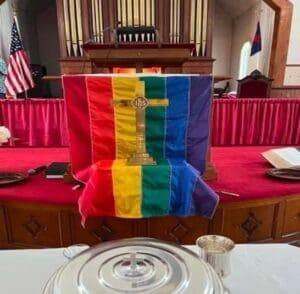
Walk into certain churches today and you may encounter something that would be almost unrecognizable to Christians who worshiped in the same denominations only a generation ago. Rainbow flags surround the sanctuary. Pastors preach in Pride-colored vestments. Worship services feature queer hymns and transgender themes. Glitter replaces traditional ashes. Rainbow bread appears at Communion. Special ceremonies celebrate transgender name changes, while Pride Month brings its own sermons, liturgies and church celebrations. These aren’t simply changes in decoration or attempts to make visitors feel welcome. Taken together, they reveal how deeply LGBTQ+ ideology has worked its way into the worship and theology of parts of the modern church. Christianity already has its own worship, hymns, sacraments, symbols, sacred language and understanding of identity. Increasingly, each is being reworked through the lens of sexuality and gender. (“10 Ways LGBTQ+ Ideology Is Reshaping the Church,” by PNW staff, Prophecy News Watch, RR News, September 16, 2026)
The Prophecy News Watch story goes on to give ten specific and clearest examples of how LGBTQ+ forces are fulfilling the 2 Thessalonians 2 prophecy by apostatizing within churches formerly of true faith, as I understand the report. I will let the reader find the item and read the details of ten specific ways this is happening. Here they are in brief.
10. Transgender Worship Leaders and Bands
The worship platform has become one of the most visible places for churches to demonstrate LGBTQ+ affirmation. Transgender and nonbinary worship leaders are sometimes deliberately celebrated as representatives of a congregation’s commitment to queer inclusion.
9. Queer Hymns and Trans-Inclusive Worship Songs
Even the songs are being rewritten.
8. Glitter Blessings
Few examples capture the transformation as vividly as “Glitter Ash Wednesday.”
7. Rainbow Communion
Even the Lord’s Supper has received a Pride makeover.
Communion was given to point Christians toward the broken body and shed blood of Jesus Christ. When Pride symbolism surrounds—or becomes part of—the sacrament itself, the symbolism competing for the congregation’s attention is impossible to ignore.
6. Transgender Renaming Ceremonies
Some churches now conduct special ceremonies recognizing the new names and gender identities of transgender members.
5. Pride and Trans-Themed Sermons
The transformation inevitably reaches the pulpit.
At that point, the debate has moved far beyond hospitality. It has become a debate over who gets to define Christian truth.
4. Rainbow Symbols Throughout the Sanctuary
Sometimes you don’t need to hear the sermon to understand what a church is proclaiming.
Rainbow flags hang from sanctuary walls. Pride banners appear around altars. Churches illuminate their buildings in rainbow colors. LGBTQ+ symbols appear on church signs, windows and Communion tables—sometimes within sight of the cross itself.
3. Rainbow Clergy Vestments
Pastors themselves have become part of the visual transformation.
2. Queering the Bible
This transformation reaches much deeper than flags and clothing.
Queer theology can reinterpret Scripture through LGBTQ+ categories, challenge historic Christian understandings of sexuality and gender, reconsider biblical relationships through a queer lens and alter traditional language concerning God.
1. Pride Has Become a Church Season
Christmas. Easter. Pentecost. Now some churches effectively add Pride Month to the calendar. It is most interesting to see this end-times falling away spiritually. Much more than merely interesting, however, it is most telling of exactly how near we must be to the moment of Rapture—that Departure we as Christians are looking for—and the appearance of Antichrist—a matter we are thankful not to experience. Here again is how to make sure you go to Christ in that departure and are not left behind to suffer that coming seven years of Antichrist-spawned Tribulation.
That if you will confess with your mouth the Lord Jesus, and will believe in your heart that God has raised Him from the dead, you will be saved. For with the heart man believes unto righteousness; and with the mouth confession is made unto salvation. (Romans 10: 9-10)
WITCHES ARE FINDING JESUS
WHILE LIBERAL CHURCHES ARE REINVENTING HIM
PNW STAFF, SEPTEMBER 28, 2026

Something strange is happening in America’s spiritual landscape. Witchcraft, tarot, paganism and occult spirituality have moved out of the shadows and into the mainstream. Social media is filled with tarot readings. Online marketplaces sell spells and curses. Hollywood increasingly presents witches as sympathetic, empowered spiritual seekers, while younger Americans experiment with practices their grandparents would have immediately recognized as occult. But at the same time, something remarkable is happening in the opposite direction.
Some people immersed in tarot, New Age spirituality and occult practices are discovering Jesus Christ—and concluding that following Him means leaving those things behind. Meanwhile, inside some of America’s most progressive churches, the movement appears to be going the other way. Instead of allowing Christianity to challenge the culture, biblical language is being reconsidered, historic sexual ethics discarded and even traditional understandings of God and Jesus reimagined. The irony is difficult to miss. Some people outside the church are discovering that Jesus requires them to change. Some people inside the church seem determined to change Jesus.
When A Tarot Reader Meets Jesus
Alexandra Ashcroft built an enormous audience as “Alex Reads Tarot.” Nearly one million people followed her online, where tarot wasn’t merely a private curiosity. It was her platform, identity and business. Then something changed. In June, Ashcroft wiped away her tarot content and announced that she had become a Christian. “Jesus Christ has saved my life, and I can no longer ignore that reality,” she told her followers. She explained that the transformation hadn’t happened overnight. For nearly a year she had been questioning, praying and wrestling with what she believed. Eventually, Christianity became incompatible with the spiritual practices that had made her famous. So she walked away. Her old account had accumulated tens of millions of likes. Yet she abandoned the very content that had built her following.
Then consider Kat Von D. The famous tattoo artist had long cultivated a dark, macabre aesthetic and possessed books dealing with witchcraft, the occult and tarot. In 2022 she publicly announced that she was getting rid of them.
“I got a lot of things wrong in my past,” she wrote. Von D later described some of the alternative spiritual practices she had pursued as empty attempts to fix something deeper. Eventually she began attending church, embraced Christianity and publicly underwent Christian baptism.
These stories contain an extraordinary irony. People immersed in occult and alternative spirituality can reach a moment when they recognize that following Jesus means surrendering things that are incompatible with Him. But what happens when churches stop asking anyone to surrender anything?
When Christianity Stops Correcting The Culture
Consider what is happening within the Presbyterian Church (U.S.A.). Developments inside America’s largest mainline Presbyterian body illustrate something much bigger happening throughout progressive Christianity. Rev. Jim Rigby has pastored St. Andrew’s Presbyterian Church in Austin, Texas, for decades. Recent undercover footage showed Rigby explaining that the congregation typically gives new members The Inclusive Bible, a translation deliberately constructed to reduce gendered language. Rigby praised it for being “good on the gender stuff.” Reporting on the translation notes that it alters traditional formulations involving titles such as “Son of God.”
Rigby’s theology goes considerably further. The Texas Tribune reported this year that he avoids traditional Christian prayers and creeds in services because he doesn’t want non-Christians to feel excluded. It reported that he sees Jesus as closer to a “loving atheist than an indifferent theologian.”
Think about the contrast. A tarot reader encounters Christianity and concludes that she must abandon tarot. Meanwhile, inside a Christian church, elements of traditional Christianity become the things that must be abandoned. And Rigby isn’t simply an isolated minister operating completely outside his denomination’s trajectory. PC(USA)’s own website enthusiastically profiled Rev. Bethany Peerbolte and her online “Progressive Christian message.” Peerbolte became widely noticed after appearing with a transgender stole. She explained that she began creating content after finding online Christianity too focused on the afterlife rather than social justice. The denomination now officially celebrates “all gender identities and sexual orientations,” and its constitution was amended to specifically include sexual orientation and gender identity among categories protected in church participation.
This summer, its General Assembly went further, approving a mechanism allowing congregations to identify themselves as ready to call LGBTQIA+ pastors. During the debate, one trans nonbinary Presbyterian pastor argued against the proposal—not because LGBTQ theology had gone too far, but because queer pastors should be able to enter congregations that haven’t yet had those conversations and “help people grow.” The transformation isn’t occurring outside the institution. It is occurring through it.
Finding Jesus Or Reinventing Him?
This brings us to the deeper issue. Paul warned Timothy about people “having a form of godliness, but denying the power thereof.” Jesus reserved some of His strongest rebukes not for obvious pagans but for religious authorities convinced of their own righteousness. They knew religious language. They attended religious gatherings. They believed themselves to be serving God. That should give modern Christians pause.
The occult practitioner at least understands that tarot, spells and divination aren’t historic Christian practices. If she encounters Christ and becomes convinced He is Lord, the decision before her becomes remarkably clear:
Leave the old life behind. That is essentially what Ashcroft did. It is what Kat Von D says happened as she began reevaluating the spiritual influences she had welcomed into her life. But imagine the progressive—or “woke”—Christian who has never been told that anything needs to be left behind. His pastor affirms him. His denomination affirms him. Difficult biblical passages can be reinterpreted or rewritten. Historic Christian moral boundaries become relics of an unenlightened past. Eventually Christianity ceases to challenge the culture because the culture has become the standard by which Christianity itself is judged. And when Christianity must constantly be reconstructed to agree with the surrounding culture, an unavoidable question eventually arises:
Are we still following Jesus—or creating a Jesus who follows us?
The Great Spiritual Reversal
Christians shouldn’t shrug at America’s fascination with witchcraft. Scripture could hardly be clearer about divination, sorcery and attempts to obtain spiritual power apart from God. But perhaps Christians should spend considerably less time marveling that witches exist and considerably more time asking what has happened inside the Church. Because one of the strangest religious stories of our moment isn’t simply that tarot readers can accumulate enormous followings.
It’s the direction people are traveling. Alexandra Ashcroft walked away from the tarot content that helped make her famous because she became convinced that Jesus Christ was real. Kat Von D threw away occult and witchcraft books, rejected New Age spirituality, began attending church and eventually entered the waters of baptism. They didn’t demand that Christianity accommodate what they already believed. They concluded that they needed to change. Yet in some progressive churches, the movement appears reversed. Instead of asking whether the culture conforms to Scripture, Scripture is increasingly interpreted through the culture. Instead of asking whether our desires conform to Christianity, Christianity is reconstructed around our desires. Instead of allowing Jesus to challenge us, we create a Jesus who conveniently agrees with us. And perhaps that is the great spiritual irony of our age. While some people once fascinated with the occult are discovering Jesus and leaving their old beliefs behind, some churches bearing His name are working feverishly to make Him indistinguishable from the culture outside their doors. One movement says: “I was wrong. Christ must change me.” The other increasingly says: “Christianity was wrong. We must change it.”
Both cannot be the Gospel. And the strangest possibility of all is that while Christians have been watching the rise of witchcraft outside the Church, the far more consequential spiritual battle may have been unfolding inside it.
THE PICK-AND-CHOOSE BIBLE
A GENERATION WANTS SCRIPTURE WITHOUT ITS AUTHORITY
PNW STAFF, SEPTEMBER 30, 2026

Something strange is happening among America’s younger Christians. They haven’t necessarily abandoned the Bible. Many are still attending church. Some are reading Scripture with renewed interest. They may quote it, discuss it, post verses from it and describe it as important to their faith. But increasingly, they appear unwilling to let it have the final word. That is the troubling picture emerging from new Lifeway Research findings showing a widening generational divide over biblical authority. Among Protestant churchgoers ages 18 to 29, 54% agreed that “as culture changes, some biblical truths become obsolete.”
Think about what that means. These aren’t statistics drawn exclusively from atheists, agnostics or people who walked away from Christianity years ago. Lifeway surveyed Protestant Americans who attend church at least monthly. Yet more than half of the youngest adult churchgoers surveyed believe cultural change can apparently place an expiration date on biblical truth. And that may tell us more about the future of American Christianity than declining attendance ever could.
The Bible As Adviser Instead Of Authority
There is an enormous difference between struggling with something the Bible teaches and believing you possess the authority to discard it. Christians have wrestled with difficult passages for two thousand years. They have debated interpretation, doctrine and application. Serious Christians can disagree about what particular passages mean. But historically orthodox Christianity begins with a fundamentally different assumption: Scripture judges us. We don’t judge Scripture. Increasingly, that relationship appears to be reversing. Lifeway found that 34% of Protestant churchgoers say they accept some truths from the Bible while others “do not fit what they believe,” up from 30% in 2019. Among churchgoers ages 18 to 29, that figure reaches 56%. That wording is revealing. The question is no longer simply, “What does the Bible teach?” It becomes, “Does what the Bible teaches fit what I already believe?” Once that happens, Scripture has ceased functioning as an authority. It has become an adviser. We consult it, appreciate the portions that affirm us and quietly dismiss those that don’t. It is Christianity with an edit button.
Culture Gets The Deciding Vote
This helps explain what has happened inside portions of American Christianity. The Bible hasn’t suddenly changed its teaching about marriage, sexuality, sin, repentance, judgment, salvation or the identity of Christ. The surrounding culture has changed. And wherever Scripture collides with the prevailing values of the age, Christians increasingly face a choice: allow Scripture to challenge the culture, or allow the culture to reinterpret Scripture. The temptation to choose the latter is enormous. It is much easier to announce that an uncomfortable biblical teaching belongs to another time than to tell friends, coworkers or children that Christianity places boundaries around human desires. It is easier to redefine sin than call people to repentance. It is easier to reinterpret Jesus than submit to Him. And eventually Christianity can be reconstructed into something remarkably compatible with whatever society already believes. The result may still have churches. It may still have worship music, clergy, crosses, Bible studies and Christian vocabulary. But who actually has authority? That is the question.
The Encouraging Part Of The Story
There is another development taking place that makes these findings even more fascinating. Young Americans appear increasingly interested in the Bible. Barna reported that weekly Bible reading among American adults climbed sharply in 2025, with particularly strong engagement among younger generations. That should be encouraging. After years of warnings about biblical illiteracy, a generation shaped by social media, political turmoil, loneliness and rapidly changing technology may be looking again for something deeper and more permanent. But reading Scripture and submitting to Scripture are not necessarily the same thing. A person can open the Bible searching for wisdom while still reserving the right to reject anything that conflicts with his worldview. That may be the defining spiritual struggle of this generation.
Will young Christians approach Scripture asking, “What does God require of me?” Or will they approach it asking, “How can this be reconciled with what I already believe?” Those questions may sound similar. They lead in opposite directions.
When Truth Becomes Personal
The Lifeway findings reveal another striking generational difference. Among churchgoers ages 18 to 29, 87% agreed that the truth of God’s Word can mean different things to different people. There is a legitimate sense in which Scripture applies differently to people in different circumstances. But if the underlying truth itself becomes personalized, Christianity enters dangerous territory. Because Christianity makes claims that aren’t merely personal.
Christ rose from the dead or He didn’t. Sin separates humanity from God or it doesn’t. Christ is the way to the Father or He isn’t. God established moral boundaries or He didn’t. Those claims cannot simultaneously mean contradictory things simply because different people prefer different conclusions. Jesus did not present truth as infinitely customizable. He said, “I am the way, the truth, and the life.”
The Coming AI Bible
And now this struggle is arriving at exactly the moment artificial intelligence is becoming a powerful interpreter of information. That combination deserves much more attention. Barna reported in 2026 that large majorities of practicing Christians and pastors are concerned about AI misinterpreting Scripture. At the same time, AI is rapidly becoming a normal place for people to ask deeply personal questions about relationships, morality, purpose and spirituality.
Imagine where this leads. For most of Christian history, someone wrestling with a biblical teaching might consult a pastor, commentary, theologian or mature Christian. Now he can ask an algorithm. And if he doesn’t like the first answer, he can rephrase the question. Again. And again. Until he receives an interpretation comfortable enough to accept.
The danger isn’t merely that AI could misunderstand the Bible.
The greater danger may be that humans will use AI to construct exactly the Bible they want.
A Christianity customized to the individual. No uncomfortable doctrines.
No unwanted restrictions. No difficult demands. Just affirmation on demand.
The Question Every Generation Must Answer
Every generation encounters biblical teachings it would rather avoid. Ours isn’t unique in that regard. What is different is the growing assumption that cultural change itself can make biblical truth obsolete. If that principle is accepted, there is ultimately no fixed point left. Culture changes constantly. What society celebrates today may embarrass it fifty years from now. Moral fashions rise and fall. Political movements appear and disappear. Entire philosophies that once seemed unquestionably modern eventually end up in history books. Christianity makes a radically different claim. “Jesus Christ is the same yesterday and today and forever.” The church therefore cannot measure Scripture against the culture and keep whichever one seems more modern. It must decide which one possesses authority. Because once Christians reserve the right to decide which biblical truths remain acceptable, the Bible may still sit on the nightstand. It may still be carried into church. It may still be quoted on Sunday morning. But it is no longer really in charge. And a generation that wants Scripture without its authority may eventually discover that it has kept the Bible while creating an entirely different religion.