Watch Live

Jesus’ Journey to Jerusalem

“From Gethsemane to Golgotha” Selected Scriptures

Date:March 29, 2026
Author: Wayne J. Edwards

Introduction:

In 325 A.D., the Council of Nicaea separated the celebration of the Christian resurrection from Passover, anchoring it to the first Sunday after the first full moon following the vernal equinox. This linked it to the pagan fertility festival of “Easter,” blending biblical truth with pagan traditions. The main motivation was to create a unified Christian practice independent of Jewish influence. Emperor Constantine advocated for this separation, stating, “Christianity would have nothing in common with the Jews.”

However, whether Constantine was a “true” Christian is debated, as he likely merged personal belief with political pragmatism. While he stopped the persecution of Christians, built physical churches, and favored Christianity, seeing it as a force for unity and peace within the empire, Constantine retained his commitment to pagan elements, such as the worship of Sol Invictus (the Unconquered Sun).

Beloved, Christianity was born as a Jewish messianic movement, centered on the life, death, and teachings of Jesus of Nazareth, a Jewish Rabbi. With the exception of Luke, the original apostles were Jewish and adhered to Jewish traditions, culture, law, and the seven Jewish feasts.

By moving the date away from the 14th of Nisan (Passover), the church broke from the biblical timeline. This decision weakened the theological connection to Jesus as the fulfillment of the Passover Lamb and diminished the Lord’s physical resurrection as the fulfillment of the Feast of Firstfruits.

The title of this sermon is: “Jesus’ Journey to Jerusalem – From Gethsemane to Golgotha.”

Thank you for your continued support. Please share these guides with anyone who may find them helpful.

Download the following translated Sermon guides:

English translated Sermon Guide
Spanish translated Sermon Guide
Portugal translated Sermon Guide
Filipino translated Sermon Guide
Swahili translated Sermon Guide
Heritage Baptist Church Sermon

Old Testament Reading: Zechariah 9:9-10
New Testament Reading:  Matthew 21:1-10

Jesus’ Journey to Jerusalem
“From Gethsemane to Golgotha”
Selected Scriptures

   Even unbelievers acknowledge the crucifixion and resurrection of Jesus as the two essential doctrines of the Christian Faith, for without those events, we have no gospel.

  • By the end of the first century, Sunday was referred to as “The Lord’s Day” and reserved for corporate worship, including the celebration of Jesus’ resurrection.
  • Annually, the celebration of the Lord’s resurrection was observed at the same time as the Jewish Feasts of Passover, Unleavened Bread, and First Fruits, for Jesus had fulfilled them all.
  • In 325 A.D., the Church severed the annual celebration of the Lord’s resurrection from its connection to the Jewish Passover and instructed Christian churches to celebrate the resurrection in connection with the first day of spring.
  • That decision distorted the truth and diminished the spiritual significance of the resurrection so much that the celebration of “Easter” became more important than the
    “Resurrection of Jesus Christ.”

   Over time, the celebration of Jesus’ resurrection merged with “Easter”, or “Ishtar,” the name of a false god of fertility that was worshipped by pagans in Mesopotamia and Syria.

  • Many Easter symbols originated in the pagan spring festivals of Europe, Egypt, and the Middle East, including the “rabbit” – a symbol of sexual pleasure and fertility.
  • Connect the celebration of Ishtar – the rebirth of nature, with rabbits – the symbol of fertility, and we have the origin of the Easter Bunny…. that “lays chocolate eggs”!

   Even those religious activities that God designed to keep our minds focused on the resurrection are not according to the timeline given to us in the Scriptures. In fact, the Good Friday-Easter Sunday tradition actually denies the only sign Jesus offered the religious leaders to prove His deity.

“For as Jonah was three days and three nights in the whale’s belly, so shall the Son of man be three days and three nights in the heart of the earth.”
John 12:40

   The miracle of Jonah was a “type”, or an illustration of the death, burial and resurrection of Jesus.

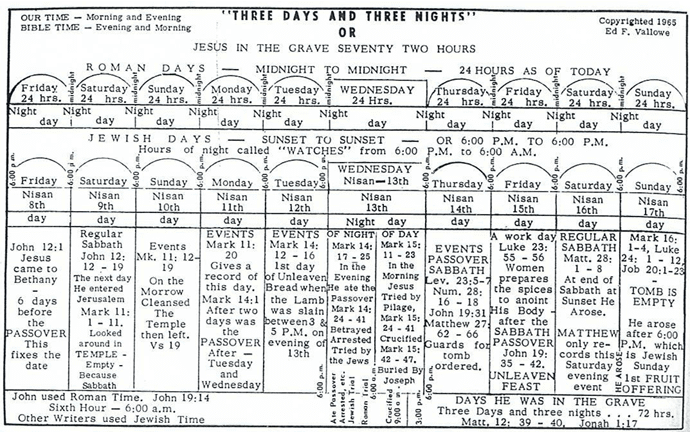
  • Three days and three nights equal 72-hours, and it is impossible, by any method, to get 72-hours using the Friday Crucifixion – Sunday morning resurrection model.
  • Matthew, Mark, and Luke wrote their gospel on Jewish time – “sunset to sunset,” or as God said in Genesis, “the evening and the morning were the first day.” John wrote his gospel much later and used Roman time.
  • Beginning at 6:00 pm Saturday, (Sunday, Jewish time) and counting backward 72-hours, Jesus had to have been buried by 6:00 pm on Wednesday for the “sign” He gave the religious leaders to be true.
  • In 1st Corinthians 15:4, the Apostle Paul said Jesus “was buried, and rose again the third day, according to the scriptures.”

COUNTDOWN TO THE CRUCIFIXION

Events recorded in:

Matthew

Mark

Luke

John

Friday – Nisan 8 – Six Days before The Passover
Jesus arrived in Bethany

12:1

Mary anoints Jesus for burial

12:1-8

Plot to kill Lazarus

12:9-11

Judas betrays Jesus for money

26:14-16

14:10-11

22:3-6

Saturday – Nisan 9 –Five Days Before the Passover – Regular Sabbath Day
Jesus enters Jerusalem

21:1-11

11:1-10

19:29-44

12:12-19

Jesus weeps over Jerusalem

19:41

Returns to Bethany with disciples

11:11

Sunday – Nisan 10 – Four Days Before the Passover
Jesus curses barren fig tree

21:18-19

11:11-18

Jesus cleanses the temple

21:12-13

11:15-18

19:45-48

Plans to kill Jesus increases

11:18-19

Greeks seek to see Jesus

12:20-36

Jesus returns to Bethany

11:19

Monday – Nisan 11 – Three Days Before the Passover
Fig tree is withered

21:18-22

11:20-26

Jesus Teaches Publicly

21:23-25:46

11:27-13:37

20:1-21:36

  • Parables – two sons, wicked husbandman, great supper, great commandment, paying taxes, woes to scribes and Pharisees
  • Prophecy – Olivet discourse, destruction of the Temple, persecution, and the destruction of Jerusalem
  • Parables – fig tree, flood, servants, ten virgins, talents
  • Prophecy – sheep and goats/last judgment
Tuesday, Nisan 12 – Two Days Before the Passover
Plans to kill Jesus increase

26:1-5

14:1-2

22:1-2

Disciples prepare Upper Room

26:17-20

14:12-17

22:7-14

Wednesday, Nisan 13 – One Day Before the Passover (sunset)
Jesus washes the disciple’s feet

13:1-20

Jesus identifies His betrayer

26:21-25

14:18-21

22:21-23

13:21-30

Last Supper Instituted

26:26-29

14:22-25

22:15-20

Judas leaves the room

13:32

Jesus gives new commandment

13:31-35

Jesus warns all will flee

26:31-35

14:27-31

22:31-38

13:36-38

Jesus Upper Room Discourse

14:1-31

They sing a hymn and leave

26:30

14:26-31

Jesus teaches along the way Chaps.15-17
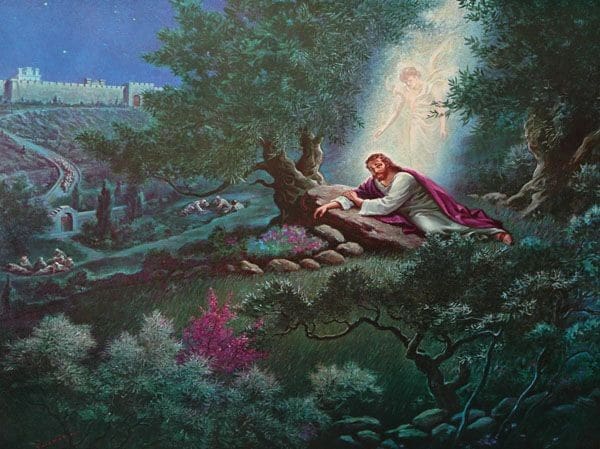
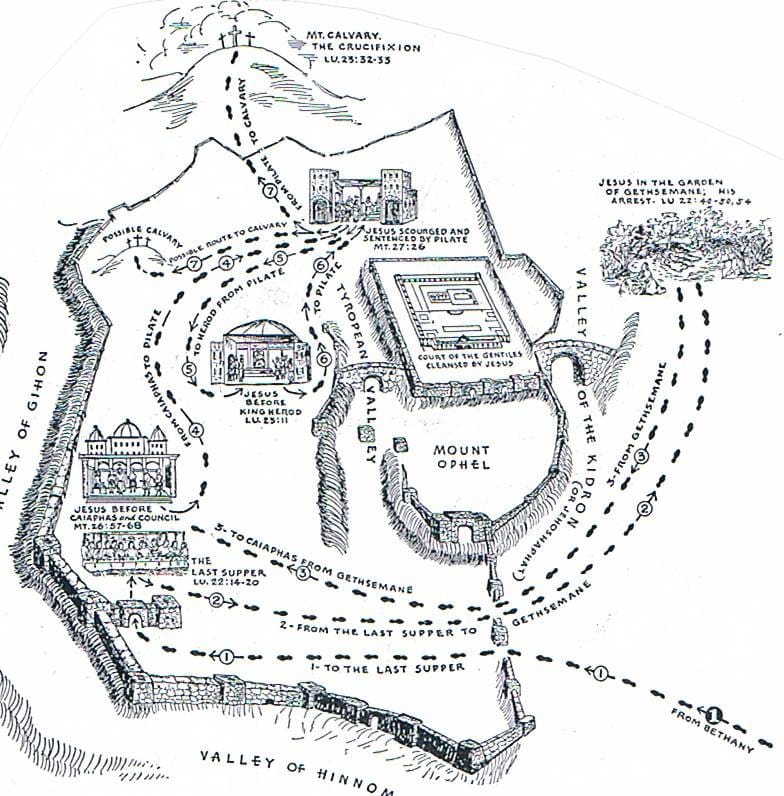
Jesus prays at Gethsemane

26:36-46

14:43-52

22:39-46

Jesus betrayed, arrested

26:47-56

14:43-52

22:47-53

18:2-13

Midnight – Jesus taken to Annas for questioning
1:00-200 am – Jesus taken to Caiaphas for questioning
5:00-6:00 am – Jesus stands before Sanhedrin – mock trial
6:00-7:00 am – Jesus stands before Pilate for sentencing
7:00-8:00 am – Jesus stands before Herod for sentencing
8:00-9:00 am – Pilate and Herod found Jesus to be innocent
9:00-10:00 am – Jesus was beaten, scourged, mocked and paraded through the city of Jerusalem, carrying the top beam of the cross
12:00 noon – Jesus was nailed to the cross between two thieves
12:00-3:00 pm – Darkness covered the area for miles
3:00 pm – Jesus cried out “It is finished – Father, into Thy hands I commend my spirit.”
3:00 pm – an earthquake occurred, the temple veil was torn, area graves were opened, the Roman Centurion confessed Christ
Joseph of Arimathea and Nicodemus prepared the body and buried it in a tomb nearby; the Roman’s sealed it and guarded it

Secret Link