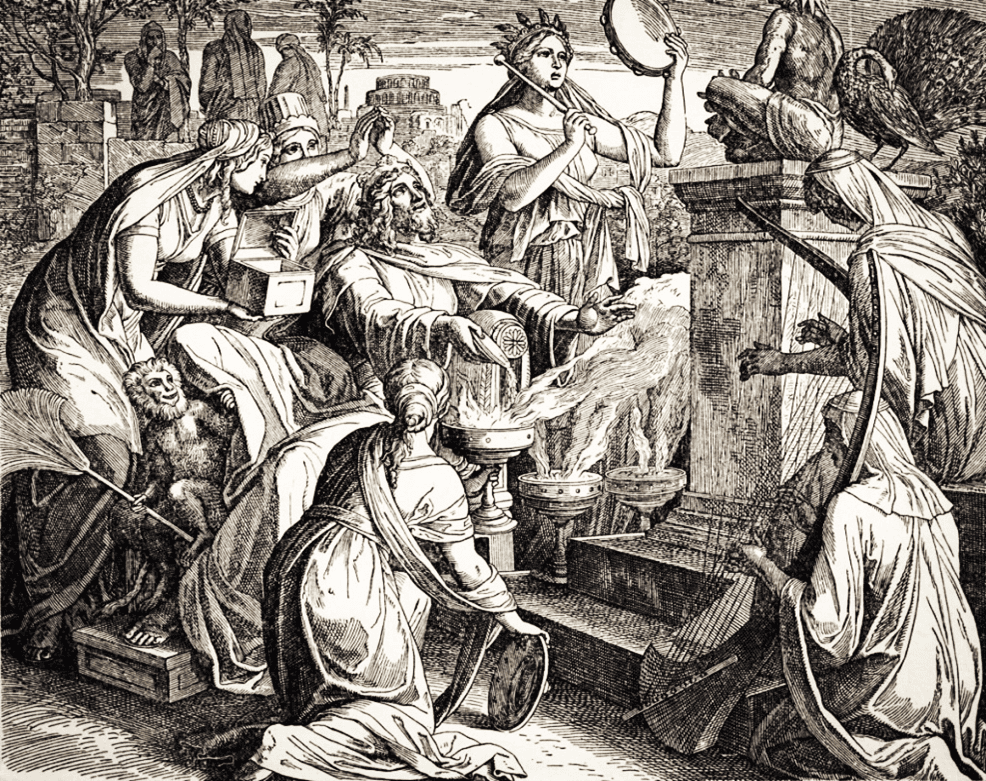
“Horrors in the House of God”
Ezekiel 8:1-18
Wayne J. Edwards, Pastor
In Hebrew, the name “Ezekiel” means “God strengthens,” or “God is strong.”
- The name combines the Hebrew word for “God” (El) with a form of the verb “chazaq,” meaning “to strengthen”.
- While Ezekiel was contemporary with Jeremiah, Daniel, and Zechariah, he was also a priest to whom God gave visions, signs, and symbols to dramatize the disobedience of God’s people, to show them why they had been removed from their homeland and exiled in Babylon.
- Young Eziekiel and his wife were among the first 10,000 Jews to be taken to Babylon in 597 BC, and they lived on the bank of the Chebar River until his wife died.
- While the Bible doesn’t tell us exactly how Ezekiel died, historians believe he was killed by some Jewish leaders who were offended by his graphic demonstrations of their sins.
WORSHIP THAT IS PLEASING TO GOD
MUST BE CENTERED ON GOD, AND GOD ALONE.
Since the primary purpose of man is to glorify God and praise Him forever, the primary purpose of worship is to glorify God and give Him pleasure corporately. To do anything else, regardless of intentions, is to shift the focus from our devotion to God to the enjoyment of man.
- While our worship of God should be filled with joy, for every Sunday is a celebration of the glorious resurrection of our Lord and Savior, Jesus Christ, to worship God in Spirit and in Truth means we must balance our glorious jubilation with our sincere humiliation, lest the focus of worship shifts to the event itself, and not the One we say we have come to worship.
- While we are to come before the Lord with thanksgiving in our hearts and fill His courts with praise, to worship God in Spirit and in truth, we must balance our exuberant celebration with a time of Biblical edification and reverent mortification, where we confess our sins before a Holy God, and cry out unto Him for His forgiveness.
- Therefore, if our worship events do not focus on preaching the gospel that can set sinners free from the sinful world, we are actually using that time that belongs to God to further conform the sinners to the ways and wickedness of the world.
God was ready to bless Judah. However, their selfish indulgence had brought them to the end of God’s mercy, and God allowed the armies of Babylon to besiege the cities and to take the people as captives to Babylon.
- God called the prophet Ezekiel to graphically demonstrate the sinful disobedience of Israel and Judah.
- In the first few chapters, Ezekiel exhibited the people’s selfishness by eating a scroll, depicting a barbershop scene, and displaying bed of hot coals as a picture of God’s judgment.
- In chapter 8, the Holy Spirit of God took Ezekiel to the temple in Jerusalem, where God showed him the terrible idolatry that had been practiced by the people of Israel.
God used Ezekiel to remind his people that the temple had been set apart for the people to express their worship of Him. Therefore, whatever they did inside or outside the temple needed to reflect His holiness. Theologically, the 8th chapter of Ezekiel affirms the inerrancy of God’s Word, His absolute sovereignty, omniscience, and holiness, the seriousness of idolatry, and the biblical principle that God’s judgment is the necessary consequence of sin.
1. God sees what happens in His House – Ezekiel 8:1-6
- This verse begins with a precise historical marker, showing that Ezekiel’s visions are rooted in real history. These events occurred around 592 BC, during the time Ezekiel lived in exile in Babylon. The mention of the elders sitting before him suggests that Ezekiel had already gained recognition as a prophet among the exiles.
- The phrase “the hand of the Sovereign Lord came on me” means God’s power suddenly came upon Ezekiel, preparing him for a prophetic vision.
- This affirms the doctrine of divine inspiration – God initiates revelation, not human imagination (2 Peter 1:21).
- God still reveals His truth through His word today, and His word has full authority in the lives of His people.
- Every time we open Scripture, we are encountering the Sovereign Lord who speaks.
- This is no ordinary vision – Ezekiel is actually in the presence of the holy God. The Holy Spirit lifted Ezekiel “between earth and heaven” and carried him to Jerusalem, and to the entrance of the inner court of the temple.
- Ezekiel saw an idol at the entrance – a clear violation of God’s law (Exodus 20:3-5).
- This idol is called the “idol of jealousy” because it provokes God’s righteous jealousy.
- God’s jealousy is not a petty human emotion; it is His holy response to covenant betrayal.
- Exodus 34:14 – “For you shall worship no other god, for the Lord, whose name is Jealous, is a jealous God.”
2. God exposes hidden sin – Ezekiel 8:7-12
- God told Ezekiel to dig into the wall and see what’s happening behind closed doors. Ezekiel discovered a secret chamber filled with images of unclean and idolatrous animals, which the elders were worshiping, thinking no one was seeing them.
- The very leaders who should have been leading Israel in the true worship of God were bowing to idols. Their excuse was that the Lord had forsaken the land.
3. When we turn from God, we turn to something else – Ezekiel 8:13-16
- Ezekiel saw the women mourning for Tammuz, a pagan fertility god associated with seasonal death and rebirth.
- These women were participating in cultic mourning rituals, blending pagan practice with temple worship, violating the clear command in Deuteronomy 6:4-5.
- Ezekiel saw 25 priests with their backs toward the temple of the Lord and their faces toward the east, worshipping the sun.
- This was the ultimate insult – rejecting God to embrace idolatry directly in front of His sanctuary.
4. Sin is never trivial to a Holy God – Ezekiel 8:17-18
- To the people, these compromises seemed small or even culturally acceptable. But to God, they were detestable.
- When sin becomes normalized, judgment becomes unavoidable. God will not ignore sin forever.
- Sin is never trivial to God. What we might excuse as “normal” or “cultural” is deeply offensive to God’s holiness.
- As believers, we are called to examine our lives and remove anything that competes with the worship of God.
- Christians must recover a sense of holy fear – recognizing that God takes sin seriously, even when the world downplays it.
- Living in holiness means rejecting open rebellion but also the subtle compromises that lead us away from God.
- In 1 Corinthians 3:16, the Apostle Paul said: “Do you not know that you are the temple of God and that the Spirit of God dwells in you?”