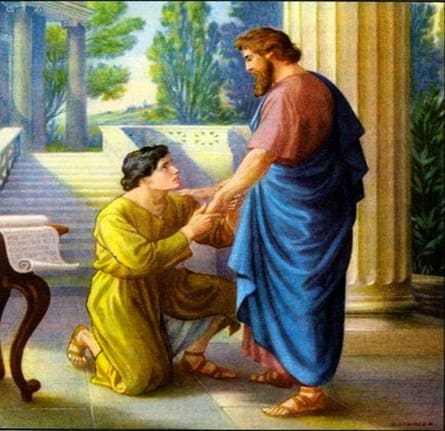
“Philemon: A Microcosm of God’s Redemptive Love”
Philemon 1:1-25
Wayne J. Edwards, Pastor
The wonderful story of Philemon’s forgiveness of Onesimus was repeated again and again as the freedom of the gospel defeated the culture of slavery.
- However, the Apostle Paul had the anointed quill, and the Holy Spirit chose this story to illustrate the essential evidence of our salvation: our willingness to forgive others of their sins and offenses, just as God, in Christ has forgiven us.
- The Bible says we are never more like God than when we take the initiative to forgive others of their trespasses against us, as God, through Christ, has forgiven us of our trespasses against Him.
The background of the three main characters:
- The Apostle Paul—was under house arrest in Rome, during which time he wrote Ephesians, Galatians, Colossians, and this letter to Philemon.
- Philemon – was a wealthy Christian slave owner who lived in the city of Colosse. Paul had led him to receive Jesus Christ as his Savior and Lord. In verse 19, Paul told Philemon, “You owe me your very self.”
- Onesimus – was a slave who had run away from Philemon and sought refuge with Paul in Rome. Paul also led Onesimus to receive Jesus Christ as his Savior and Lord. In verse 10, Paul wrote, “I appeal to you for my son Onesimus, whom I have begotten while in my chains.”
The main issue of Paul’s letter to Philemon:
- While Paul’s heart of compassion was for Onesimus, legally, he had no choice but to send Onesimus back to his owner.
- However, Paul wanted to make sure that, while Onesimus left Philemon as a rebel, since he had received Christ as his Savior and Lord, Philemon needed to accept him back, not as a slave, but as a brother in Christ.
- While slavery was allowed in Israel, it was never widespread and carefully regulated by the Laws of the Old Testament.
- However, the Roman Empire was built on slave labor. Every time the Romans conquered a new province, they added new slaves to the empire.
- In the days of the Apostle Paul, there were more slaves than there were Roman citizens. It would not have been unusual for a rich man to own as many as 10,000 or 20,000 slaves.
- Human slavery was so commonplace that no one dared to oppose it.
- Furthermore, Roman law provided little protection for slaves because they were regarded as property, not as people. Owners could mistreat their slaves, or even kill them without legal retaliation.
- So, the question theologians have raised for centuries is, knowing this, how could Paul, a Christian, send Onesimus back to Philemon?
In his letter to Philemon, the Apostle Paul used every form of coercive persuasion to make sure that Philemon understood the spiritual significance of the position he was now in.
- Verses 1-7 – Paul reminded Philemon of the depth of their personal relationship – how he prayed for him daily, and how proud he was of Philemon’s ministry to the saints.
- Verses 8-13 – Paul reminded Philemon that he had the right to force him to do what was right by Onesimus, but since Onesimus was now a brother in Christ, even though he was returning as a slave, Philemon must receive him as a brother.
- Verses 14-16 – Paul recognized the sovereignty of God in all that had happened, and the next step was up to Philemon.
- Verses 17-20 – Paul put his relationship with Philemon to the test when he said, “If you consider me a partner, then welcome him as you would welcome me.”
- Verses 21-25 – Paul begged Philemon to “refresh my heart in Christ,” by doing the right things regarding Onesimus.
- While the scriptures do not tell us that Philemon carried out Paul’s desires for Onesimus, historians believe Philemon gave Onesimus his freedom. He became the Bishop of the Church at Ephesus, with the Apostle Paul as his Rabbi.
The theme of forgiveness is predominant throughout the Bible.
- Exodus 34 – God identifies Himself as a forgiving God.
- John 15 – Jesus illustrated God’s forgiveness by telling them how a loving father forgave his son, who, after squandering his inheritance, came home and asked to be a slave, but the father received him back as a son.
- Matthew 5:7 – “Blessed are the merciful, for they shall obtain mercy.”
- Matthew 6:12 – “Forgive us our debts as we forgive our debtors.”
- Matthew 6:14 – “For if you forgive men their trespasses, your heavenly Father will also forgive you. But if you do not forgive men their trespasses, neither will your Father forgive your trespasses”
- Ephesians 4:32 – “Be kind to one another, tender hearted” – here’s the same principle – “forgiving each other just as God in Christ also has forgiven you.”
- Colossians 3:13 – “We are to be bearing with one another and forgiving each other, whoever has a complaint against anyone, just as the Lord forgave you, so also should you.”
- James 2:13 – “There will be judgment without mercy for those who have not been merciful themselves.”
- Matthew 18:22 – “I did not say to you [forgive others] up to seven times but up to seventy times seven.”
- Matthew 18:32-35 – “You wicked servant! I forgave you all that debt because you begged me. Should you not also have had compassion on your fellow servant, just as I had pity on you?’ And his master was angry, and delivered him to the torturers until he should pay all that was due to him. “So My heavenly Father also will do to you if each of you, from his heart, does not forgive his brother his trespasses.”
Here is a man who has been forgiven a massive debt who turns right around and won’t forgive somebody a small debt, and there’s that principle.
- If we want God’s mercy, we must show God’s mercy to others.
- If we want God’s forgiveness, we must be forgiving of others.
- All of us were like Onesimus; slaves to sin, chained to evil, continually running away from God.
- But Jesus went to the Cross and paid the price for our sins.
- God’s justice was satisfied once and for all and forever – all we must do is to accept the work of Christ on our behalf.
- Either we pay for our sins by spending eternity in hell, or we put our trust in the fact that Jesus paid the debt of our sins.
“We need not climb up into heaven to see whether our sins are forgiven. Let us look into our hearts and see if we can forgive others. If we can, we need not doubt that God has forgiven us.”
Thomas Watson