Victorious Christian Living
“The Choice We Must All Make”
Joshua 24:1-33
Wayne J. Edwards, Pastor
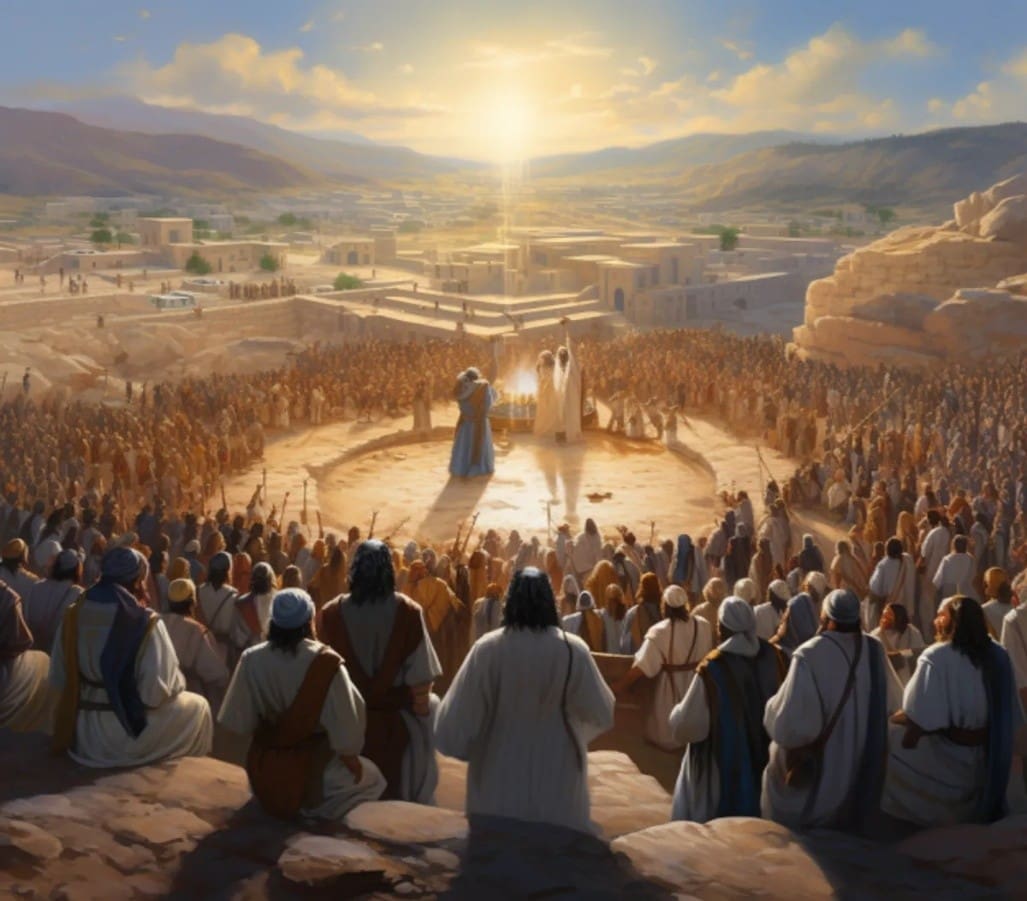
Even though many battles still lay ahead, Joshua called the Israelites to assemble at Shechem to remind them of all that God had done for them, and to lead them to renew their covenant with God, who had given them the victory.
- While every believer will still have to deal with their own sin nature and the sinful temptations of the world, having achieved peace with God through their expressed faith in Jesus Christ as their Savior and Lord, and being indwelt by the Holy Spirit, they can now live the Victorious Christian Life.
- Therefore, the reason believers should assemble on the Lord’s Day is to be reminded of God’s blessings and to renew our commitment to be absolutely loyal to the One who has given us the victory over sin, Satan, and death.
Joshua was the man God used to lead the Israelites into the land He had promised to Abraham.
- Moses was a “type” of Christ, in that many of the events of his early life paralleled the life of Christ. God used Moses to deliver the first generation of the Hebrews from their slavery in Egypt.
- Joshua’s name means “Yahweh Saves.” God used Joshua to lead the second generation of the Hebrews into the Promised Land.
- The book of Joshua began with the 2.5 million Israelites camped at the swollen banks of the Jordan River, wondering how they were going to get across it alive and it ends, 25 years later, with their tribal allotments assigned, and their homes established.
- Joshua 24:1 – “Then Joshua gathered all the tribes of Israel to Shechem and called for the elders of Israel, the heads, the judges, and their officers, to present themselves before God.”
- After leaving Haran, in obedience to God’s call, Shechem was where Abram and his family stopped and set up camp beside the Oak of Moreh. While there, God appeared to Abram and said He had given that land to him and his descendants. The Bible says Abram built an altar there and, for the first time in his life, he worshipped El Elohim, the Almighty God.
- After reconciling with his brother, Esau, Jacob bought the land he had camped on from the family of Hamor, who was Shechem’s father, for 100 pieces of silver. Jacob dug a well, buried the idols of the false gods, erected an altar and called it “El-Elohe-Israel,” The Altar to the Almighty God of Israel.
- Shechem was the place where Joseph’s brothers sold him to a band of Ishmaelites, who then sold him to Pharoah in Egypt. But, in God’s sovereignty, Joseph became the Prime Minister of Egypt, and saved his family from the famine in Israel, by asking Pharoah to allow them to live in the Land of Goshen in Egypt.
- When the Israelites left Egypt 400 years later, they carried Joseph’s bones, and as it says in Joshua 24:32, they buried them in the plot of ground that Jacob had bought from the sons of Hamor at Shechem for 100 pieces of silver.
- So, Shechem was the primary site of the foundational events for Abraham, Jacob, and Joseph, and therefore, the sacred site for the future generations of the Israelites to assemble and renew their personal, as well as their national covenant with God.
1. Remembering God’s Faithfulness – Joshua 24:1-13 – Verse 13: “I have given you a land for which you did not labor, and cities which you did not build, and you dwell in them; you eat of the vineyards and olive groves which you did not plant.”
- Joshua began his sermon with these words: “Thus says the Lord God of Israel,” and he listed the major events God had orchestrated on behalf of the Israelites.
- The call of Abraham to leave his father, his family, and his father’s faith, which was polytheism, and to go to a place that God would show him, which was Shechem in Canaan.
- God gave Abraham three descendants:
- Isaac – who foreshadowed God’s sacrifice of His Son for our sins.
- Jacob – who represented God’s election by grace and not merit.
- Esau – who represented those who choose temporary gratification over God’s offer of a spiritual inheritance.
- God made a way for Jacob’s family to avoid a famine, showing us God’s provision.
- Four hundred and thirty years later, God sent Moses and Aaron to deliver them from the Egyptians.
- God made a way for them to cross the Red Sea on dry ground and for them to see their enemies destroyed behind them.
- God made a way for them to survive in the wilderness for 40 years.
- God made a way for them to cross the Jordan River and to conquer every battle they faced with the Canaanites.
- Even as Joshua spoke, the Israelites were standing on the very land God had promised to give their father, Abraham.
- Joshua used the pronoun “I” 17 times in 13 verses, reminding the people that they did not accomplish all of this through their “sword and bow,” but that God had given them “Land for which they did not labor, and cities which they did not build, and food from vineyards and olive groves they did not plant.”
- By presenting this list of God’s actions toward the Israelites, and the Israelites alone, Joshua was reminding them that it was God who had blessed them, and, therefore, it was God who deserved their praise.
- Joshua was also laying the groundwork for his call for the people to renew their covenant with God in Joshua 24:15:
“Choose this day whom you will serve.”
2. Requesting Their Absolute Loyalty – Joshua 24:14-15 – Verse 15 – “If it seems evil to you to serve the Lord, choose for yourselves this day whom you will serve, whether the gods which your fathers served that were on the other side of the River, or the gods of the Amorites, in whose land you dwell. But as for me and my house, we will serve the Lord.”
- Joshua called the “head” of each family to make a decision.
- They could choose between the two sets of pagan or false gods; the false gods of their fathers back in Mesopotamia, the Babylonian gods, or the false gods of the Amorites in whose land they now lived.
- However, after seeing all that the God of Abraham, Isaac, and Jacob had done for them, if they were still not convinced to be loyal unto Him, then they should be honest about it, and choose between the two sets of false gods, and be loyal to the god they wanted to serve.
- In Matthew 6:24, Jesus gave the same challenge: “No man can serve two masters: for either he will hate the one, and love the other, or else he will hold to the one, and despise the other. Ye cannot serve God and mammon, or the things of man.”
3. Renewing Their National Covenant – Joshua 24:16-27 –
- Verse 16 – “So the people answered and said: “Far be it from us that we should forsake the Lord to serve other gods.”
- Verse 18b – “We also will serve the Lord, for He is our God.”
- Verse 24 – “The Lord our God we will serve, and His voice we will obey!”
- Joshua set up another stone of remembrance. He had set up stones at the crossing of the Jordan River, at Achan’s gravesite, and at the city of AI. When those who participated in those events saw those stones, they remembered what God did there, and when their children asked them about those stacks of stones, they were told to remember what God did there.
- This was the final stone, but Joshua said, this stone had eyes and ears, and each time they saw it, it would remind them of the new covenant they had made with God.
- The only thing we contributed to our eternal salvation was our sins, for God has saved us by His grace alone, and He is sanctifying us by His grace alone.
- However, knowing what He has done, is doing, and will continue to do for us by His grace alone, can we not forsake all other gods and be loyal to Him?