In the Defense of our Faith # 8
“The Testimony of the Apostle Paul”
Acts 22:1-30
Wayne J. Edwards, Pastor
In 1 Peter 3:15, the Apostle said every Christian should always be prepared to make a defense of the gospel to anyone who asks them for the reason for the hope that is evident within them and to do it with gentleness and respect.
- Therefore, the goal of apologetics is not only to strengthen the faith of those who have received Jesus Christ as their Savior and Lord but also to show them how to make the gospel so attractive to those who aren’t saved, that they will ask us for the reason for the hope they see in us.
- That puts the responsibility on every Christian to manifest that attitude of hope in our daily lives. Even when the things of the world, or the things of our lives, look hopeless, our hope is still sure in our faith in Jesus Christ as our Savior and Lord.
While the evangelical tradition focuses on the proclamation of the gospel as the entrance to a witnessing event, apologists now believe that before a lost person can be saved, they must first recognize their lostness. Dr. Francis Schaeffer referred to apologetics as “pre-evangelism,” which he defined as giving a defense for the verity and the value of the Christian Faith, and then sharing the gospel message.
- Without apologetics, a lost person may think they are saved by believing the historical facts of the gospel.
- Without the presentation of the gospel, apologetics is just another defense of the Christian Faith.
- Therefore, when someone asks us for the reason for the hope that is within us, rather than opening our Bibles or using a gospel tract, perhaps our first priority would be to give them our personal apologetics, which would begin with the testimony of our personal encounter with the Lord – i.e., our conversion experience.
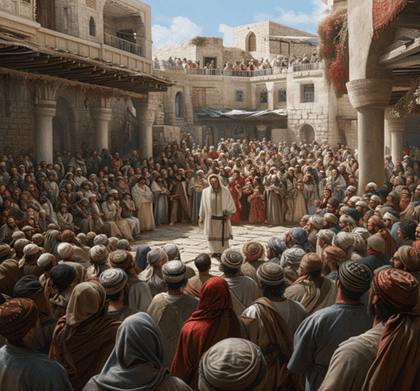
In Acts 22, the Apostle Paul gave his personal testimony to a crowd of hostile Jews who could not comprehend why he was telling the Gentiles how to be saved.
1. Paul’s Former Life – Acts 22:1-5: Vs. 1 – “Brethren and fathers, hear my defense before you now.” And when they heard that he spoke to them in the Hebrew language, they kept all the more silent.”
- The first part of our personal testimony should briefly describe our lives before we received Jesus Christ as our Savior and Lord.
- Paul didn’t provide intricate details; instead, he focused on the major highpoints of his life before that Damascus Road encounter with Christ.
- Paul was born to the tribe of Benjamin and named for their most famous member: Saul.
- Paul was born in Tarsus where his family was tentmakers, which allowed Paul to grow up in Jerusalem and be educated there—not influenced by Gentiles at all.
- Tradition says Paul started his Biblical training at the age of 5, the Mishnah at the age of 10, the Talmud at 15, an apprentice at age 20, and a teacher at age 30.
- Then Paul studied under Gamaliel, an ultra-conservative Rabbi with high moral standards. As a student of Gamaliel, Paul understood the threat of the new “Christian sect of Judaism,” which is why he opposed it.
2. Paul’s Life-Changing Encounter – Acts 22:6-16: Vs. 6-8 – “Now it happened, as I journeyed and came near Damascus at about noon, suddenly a great light from heaven shone around me, and I fell to the ground and heard a voice saying to me, Saul, Saul, why are you persecuting Me? So, I answered, who are You, Lord? and He said to me, ‘I am Jesus of Nazareth, whom you are persecuting.’
- Paul told the crowd that he was just like them until he had that personal encounter with the Lord Jesus, and his life was drastically changed.
- He told them how he was on the road to Damascus to send more Christians to the lion’s den, and all of a sudden, God arrested him with the blinding light of His glory.
- Then, Jesus identified Himself as the One Paul had been persecuting.
- Paul said he could not see, for the light of God’s glory had blinded him, and, therefore, he had to be guided into the city of Damascus, and since he was also spiritually blind, he had to be helped by a man named Ananias, who was also a devout man who had a good testimony with all the Jews.
- Paul said he remembered Ananias telling him that the God of our fathers had chosen him to know God’s will, i.e., in his mission to spread the gospel to the Gentiles, Paul was still serving the God of his fathers, for He had now been revealed to Paul in the Person and work of Jesus Christ.
The Greek word for “testimony” is the root of the English word, “Martyr. Establishing the truth about Jesus is the central “job” of every Christian – we are to be “living testimonies” of power of the gospel to change a person’s temporal life, as well as to determine that person’s eternal destiny.
- That’s why a person’s verbal testimony had to be confirmed by their visible testimony – their “words had to become flesh,” if they were to be believed.
- Human courts have a severe punishment for those who give a false testimony while under oath. Can you imagine what the punishment might be for those who give a false testimony about their faith in Jesus Christ as their Savior?
3. Paul’s New Purpose – Acts 22:17-21 – Vs. 17-18 – “Now it happened, when I returned to Jerusalem and was praying in the temple, that I was in a trance and saw Him (Jesus) saying to me, ‘Make haste and get out of Jerusalem quickly, for they will not receive your testimony concerning”
- Even though Paul had converted to the Christian Faith, he was not against all of the Jewish ceremonies and rituals.
- He said it was while he was in prayer in the Temple that he fell into a trance, and the Lord told him to get out of the city of Jerusalem quickly, for the people were not going to believe his testimony.
4. Paul’s Rejection – Acts 22:22 – “And they listened to him until this word, and then they raised their voices and said, “Away with such a fellow from the earth, for he is not fit to live.”
- They listened to him up to the point where he said God was sending him to the Gentiles, and then they shouted, “Wipe this man off the face of the earth.”
- This shows how far gone the Jews were from their part in God’s plan for the redemption of all men. They didn’t want to believe that the God in whom they believed would save Gentiles.
Each time Paul gave his testimony, he adjusted it to fit with the different audiences.
- In Acts 9, he gave a full, detailed account of his Damascus Road experience.
- Here in Acts 22, Paul gave his testimony to persuade the Jews to open their eyes to see who Jesus really was.
- In Acts 26, Paul gave his testimony to persuade the Gentiles to receive Jesus Christ as their Savior and Lord.
- In Philippians 3, Paul adjusted his testimony to give the theological basis for his faith in Jesus Christ as Lord.
- In 1 Timothy, Paul gave his testimony to the young man he had discipled for more than 20 years. When Paul wrote this first letter to Timothy, he was still considered a youth, but because the Apostle Paul had mentored him, he was respected as a mature spiritual leader, to whom Paul passed the torch in AD 67.