Victorious Christian Living
“Unity and Faithfulness to God”
Joshua 22:1-34
Wayne J. Edwards, Pastor
The Victorious Christian Life is not a pleasure cruise.
- Despite the false sales pitch many pastors are peddling today, the Bible makes it clear that our salvation isn’t a ticket to a life of leisure and luxury during our days on earth, and then a cloud soft landing in heaven when we die, but rather it is a call to sacrificial living, to do all we can to preserve the unity in our marriages, in our families, in our churches, and, in so far as it is possible for us, to live a peace with all others, so that our lives can bring glory to the Lord Jesus Christ.
- Just as God told Joshua He had given the land to the Israelites, but they had to fight for it, so it is with our goal to live the Victorious Christian Life. In John 3:16, the Apostle summed it up this way: “For God so loved the world that He gave His only begotten Son, that whosever believes in Him should not perish, but have everlasting life.”
- The word “perish” there means to waste the days of our lives trying to find peace and fulfillment in the things of this earth, rather than in God Himself.
- God has made provision for lost man to be rescued from the perishing, but it is available only to those who admit their sin, their need for a Savior, and then by faith, receive Jesus Christ as their Savior and Lord.
- To perish means to live under the impending wrath of a Holy God.
- Unsaved people perish because, rather than to receive Jesus Christ as their Savior and submit unto Him as their Lord, they continue to look for the meaning and purpose to life in the things and the pleasures of this world. But, no matter how great these things are, they are all temporary.
The headlines of the previous chapters:
- Chapters 1-5 were about crossing the Jordan River and entering the Promised Land, which parallels our total submission to Jesus Christ as our Savior and Lord.
- Chapters 6-12 were about conquering the land, which paralleled our crucifixion of every known sin, beginning with that sin that so easily besets us.
- Chapters 13-21 were about dividing the land, which paralleled our getting our lives in order.
- Chapter 21:43 – “Thus the Lord gave to Israel all the land he swore to give to their fathers, and they took possession of it, and they settled there, and the Lord gave them rest on every site just as he had sworn to their fathers. Not one of all their enemies had withstood them for the Lord had given all their enemies into their hands, not one word of all the good promises that the Lord had made to the house of Israel had failed, all came to pass.”
1. The Accusation – Joshua 22:10-12
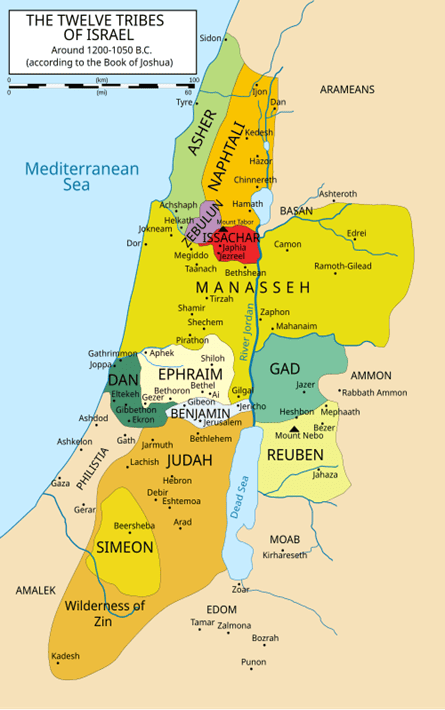
- Joshua 22:11–12, “Now the children of Israel heard someone say, ‘Behold, the children of Reuben, the children of Gad, and half the tribe of Manasseh have built an altar on the frontier of the land of Canaan, in the region of the Jordan, on the children of Israel’s side.” And when the children of Israel heard of it, the whole congregation of the children of Israel gathered together at Shiloh to go to war against them.”
- This massive altar was built at Geliloth, near the Jordan River, but in the land of Canaan. Scholars believe Geliloth was near the city of Gilgal, the first place the Israelites camped after they had crossed the Jordan, near Jericho.
- An altar is where people made their sacrifices unto God for their sins – it was their “meeting place” with God, and while God’s people built their altar for their worship of the one true God, the pagans built their altars to worship their false gods.
- However, God told His people that they were to worship Him in the place He had so designated, which at this time was at Shiloh.
2. The Investigation – Joshua 22:13-20
- Joshua 22:13-14 – “The children of Israel sent Phinehas the son of Eleazar the priest to the children of Reuben, to the children of Gad, and to half the tribe of Manasseh, into the land of Gilead, and with him ten rulers, one ruler each from the chief house of every tribe of Israel; and each one was the head of the house of his father among the divisions of Israel.”
- These men were sent to learn why the Eastern Tribes had sinned against God by building this massive altar, for, as they knew, what one tribe did affected all the tribes, and no one wanted to do anything that would cause God to be angry.
- In verses 17-20, Phinehas reminded them of the two events that stirred God’s anger against them:
- When an Israelite man was found having sexual relations with a Moabite woman.
- When Achan stole some of the spoil and hid it in his tent.
3. The Clarification – Joshua 22:21-29
- Joshua 22:21-22 – “Then the children of Reuben, the children of Gad, and half the tribe of Manasseh answered and said to the heads of the divisions of Israel: “The Lord God of gods, the Lord God of gods, He knows, and let Israel itself know—if it is in rebellion, or if in treachery against the Lord, do not save us this day.”
- Joshua 22:26-29 – “Therefore we said, ‘Let us now prepare to build ourselves an altar, not for burnt offering nor for sacrifice, but that it may be a witness between you and us and our generations after us, that we may perform the service of the Lord before Him with our burnt offerings, with our sacrifices, and with our peace offerings; that your descendants may not say to our descendants in time to come, “You have no part in the Lord.” Therefore, we said that it will be, when they say this to us or to our generations in time to come, that we may say, ‘Here is the replica of the altar of the Lord which our fathers made, though not for burnt offerings nor for sacrifices; but it is a witness between you and us.’ Far be it from us that we should rebel against the Lord, and turn from following the Lord this day, to build an altar for burnt offerings, for grain offerings, or for sacrifices, besides the altar of the Lord our God which is before His tabernacle.”
4. The Humiliation – Joshua 22:30-34
- Joshua 22:30-31 – “Now when Phinehas the priest and the rulers of the congregation, the heads of the divisions of Israel who were with him, heard the words that the children of Reuben, the children of Gad, and the children of Manasseh spoke, it pleased them. Then Phinehas, the son of Eleazar the priest said to the children of Reuben, the children of Gad, and the children of Manasseh, “This day we perceive that the Lord is among us, because you have not committed this treachery against the Lord. Now you have delivered the children of Israel out of the hand of the Lord.”
- Joshua 22:34 – The children of Reuben and the children of Gad called the altar, Witness, “For it is a witness between us that the Lord is God.”
Six principles that should help us in our desire to live at peace with all people, beginning in our homes, in our churches, and with others.
- True Peace Requires Fidelity to a Faithful High Priest.
- The Eastern tribes said they had built the altar to protect the unity among all the tribes of Israel, and to enhance their common devotion to the God of Israel, who was the Faithful High Priest.
- Under the New Covenant, Christ is our Faithful High Priest – for He has broken down every wall.
- True Peace Requires Honest Confrontation.
- While the potential conflict was based on a rumor that someone said was true, the Western tribes did the right thing in coming together at the Tent of Meeting and finding a path forward, including confronting the Eastern tribes with what they had heard.
- True peace cannot be achieved by launching mortars from a distance; there must be a meeting place.
- True Peace Requires Total Truth.
- At the end of Joshua 22, there was an even greater unity between the Western and Eastern tribes, because the Western tribes took the time to seek the truth about the accusations they had heard about the Eastern tribes. When the truth was revealed, both sides rejoiced in that no one had broken faith with the other in their common devotion to God.
- True peace can only come between husbands and wives, parents and children, and church members when there is absolute truth between them.
- True Peace Requires a Sympathetic Approach.
- Notice Phinehas began by “asking” questions rather than attacking by making wild accusations or unfounded indictments.
- If we want to achieve true peace in any relationship, we have to be more concerned about resolving the issues than we are about winning the argument.
- True Peace Requires a Humble Heart.
- Rather than excuse or even defend themselves, in their desire to achieve peace with their brothers and sisters, they just explained their motives and looked to God for His blessing.
- True Peace is a Gift from God, that we must maintain through our obedience to God.
- Proverbs 16:7, “When a man’s ways please the LORD, He makes even his enemies to be at peace with him.”